
Setting the Scene: The Amazon Rainforest
As a baby writer, I loathed writing setting. The place a story takes place never felt as exciting to me as the people in it. This remained true until I imagined my setting as a character, with a personality, hopes, and feelings. Suddenly the setting came alive as an active shaper of the story. Never has the setting been a more active player than in my latest novel set in the Amazon.
What we in the US commonly refer to as “the Amazon” is actually a massive ecosystem consisting of the Amazon River basin and the Amazon rainforest. The scale of the Amazon is difficult to comprehend. It covers 40% of South America, more than double the size of India, and almost as large as the contiguous US. The Amazon River is the world’s largest in volume and second longest. It’s Earth’s largest rainforest, home to one in ten of every known species, and, when it comes to rain—to the sheer number of drinkable dihydrogen-monoxide molecules—the Amazon basin stands alone, holding more than twenty percent of the world’s fresh water.
In 1927 Henry Ford decided to convert more than 5,000 square miles of this incomprehensibly complex web of species and systems into a beacon of modern industrial agriculture. The Ford Motor Company would build a rubber plantation and, in doing so, would bring the American way of life, complete with picket fences and fire hydrants, to the heart of the Brazilian Amazon. The town Ford’s men built became known as Fordlandia, and it’s the setting for Jungle of Ashes.

The meeting of the Amazon and Rio Negro
I visited the Amazon in 2008 while living in Brazil, and even with 21st-century transportation technology, reaching our ecolodge required multiple days on planes, boats, and automobiles. We flew from Rio de Janeiro to Manaus, the former crown jewel in Brazil’s 19th-century rubber empire. Our boat to the lodge left the next day, so we stayed in a hotel billed as a luxury resort. The long, dimly lit hallways, smelling of mildew, gave more of a tropical Overlook vibe than five stars. I learned that first day there’s no amount of cleaning that will make carpets in the Amazon a good idea.
Over breakfast my husband read in the paper that a group of graduate students had been found after being lost in the forest for several days. I found it shocking that in 2008, a group of adults who’d been conducting research in the area for weeks wandered a little far from their normal path and weren’t seen for days. This wasn’t a surprise to locals. The Amazon forest creates a solid canopy ranging from seventy to a hundred feet high that shields the forest floor 365 days a year. Infrastructure is eroded by heat and humidity faster than it can be maintained. The only major roads are rivers, and those can change width and depth depending on the rains that year. To this day, it’s very, very easy to disappear in the Amazon.
This is where Henry Ford believed he could build a utopia of American values and industrial efficiency.
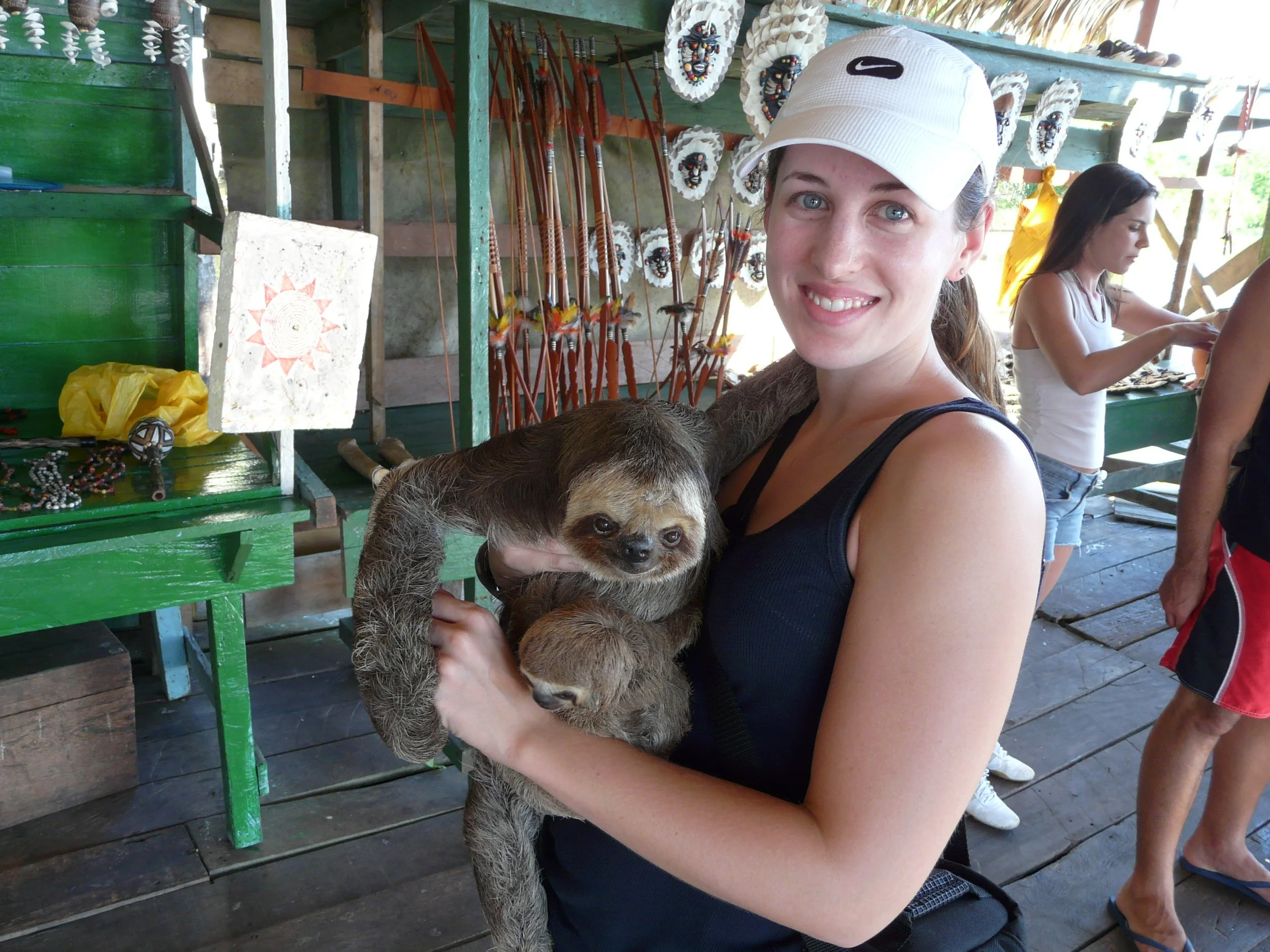
Mama sloth and baby with author Brynn Barineau
I didn’t see Fordlandia during my trip to the Amazon. The land and all property were sold back to Brazil in 1945. It’s possible to visit the small town that survived the company’s departure, but the broken remains of a failed industrial takeover of Mother Nature were not why I went to the Amazon. I wanted to meet the locals, specifically the sloths. And the macaws, howler monkeys, spider monkeys, otters, capybaras, toucans, harpy eagles, pink dolphins.
Scientists estimate a quarter of all terrestrial species live in the Amazon, including over a thousand bird species, four hundred mammal species, and three hundred reptiles. The forest is home to ants with venom that feels like a gunshot, 550-pound snakes, tiny frogs with toxic skin, hairy spiders that can stand on their back legs and inject a neurotoxin, giant cats with skull-crushing jaws, and fish that generate electricity. A fisherman could spend his entire life in the waters of the river basin and still be surprised by the catch, given the 2,400 species of freshwater fish living there.
Now, I’m a sucker for an animal encounter. If I can pet it, hold it, let it sit on my head, that’s what I want to do, so I packed the fancy camera and repellant ready to be one with all of nature except mosquitoes.
We saw two wild animals: the back of a sloth at the top of a tree and a toucan even higher up a different tree. I learned that most of the birds and monkeys live in the canopy. Fun fact, early European explorers of the Amazon frequently starved to death because anything they could eat, from fruit to monkey, was eighty feet in the air.
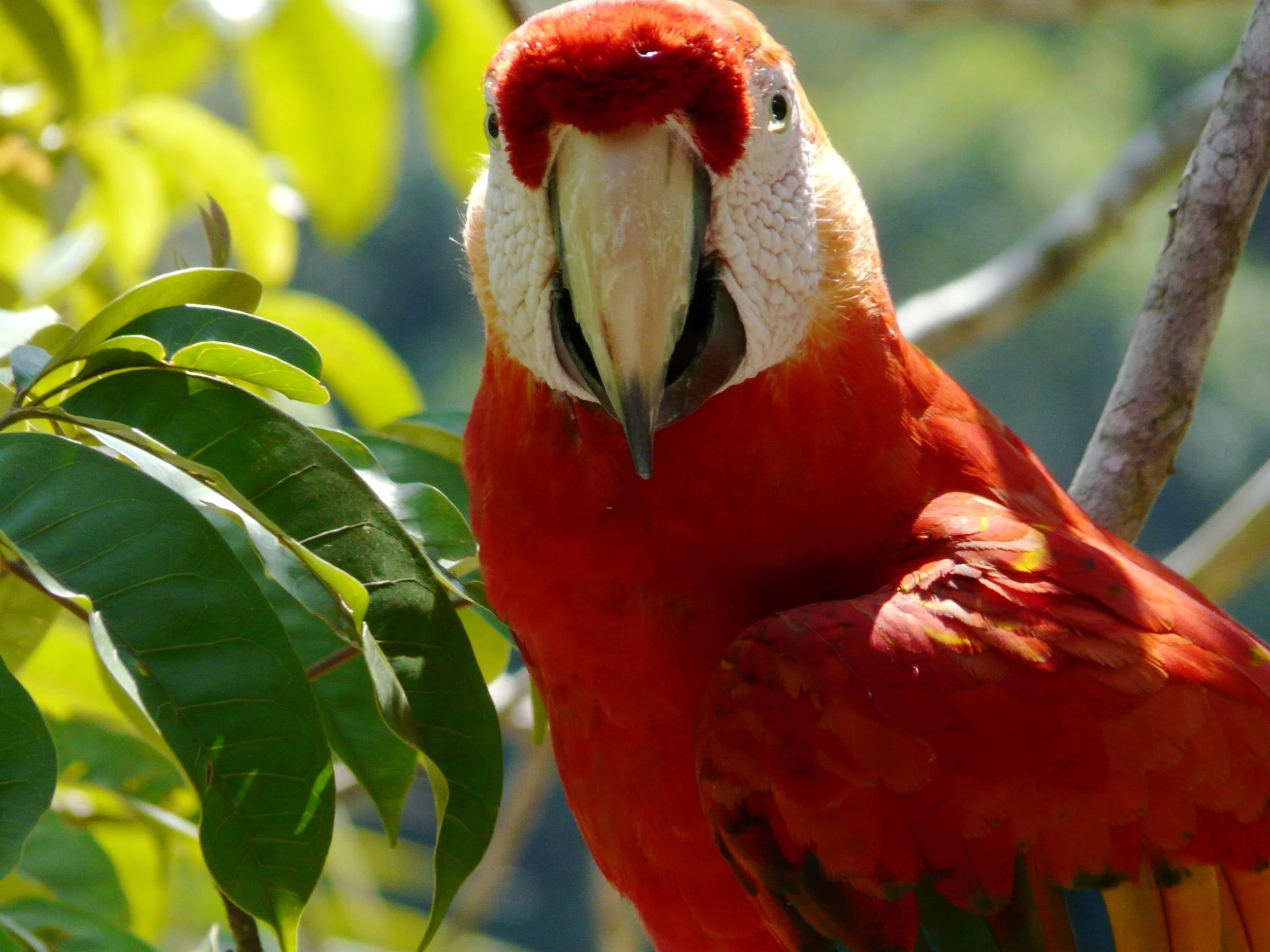
Lauro, a macaw living near a guest lodge in the Amazon
That doesn’t mean our trip was animal-free, but every animal was either part of a government rehabilitation project or some variation of a pet. Our lodge had Lauro, a macaw who lived freely in the surrounding trees, stopping by the reception or restaurant at his leisure, which was usually at meals. He could have flown off into the forest anytime, but I think he was addicted to the breakfast buffet. I don’t blame him. During our boat tour of the flooded forest, we stopped by one family-run store on the river where the children played in the river with their pet otter. Imagine kids racing and launching themselves off a wooden dock with their golden retriever, only the retriever is a six-foot-long weasel. We also visited a facility for monkeys rescued from traffickers by Brazil’s environmental police where the monkeys are slowly reintroduced to the wild before being released.
Unfortunately, Brazil has developed a robust environmental police force and legal framework out of necessity. Animal traffickers are only one of the threats. The Ford Company broke the seal on the Amazon, and despite Ford’s failure, other corporations have been looking to make a profit off of it. Powerful beef and logging companies exploit the Amazon’s size to clear cut hundreds of acres with near impunity. The scale of the Amazon makes it impossible for the Brazilian government to monitor and patrol the forest in its entirety. Protection is also complicated by the fact that the Amazon covers nine countries, and varying laws and resources make coordinated protection efforts across the entire forest nearly impossible. In addition, increasing temperatures and less rainfall has resulted in record-breaking wildfires.
In the face of so many challenges, there is hope. A recent New York Times article highlighted a massive research project done in Ecuador showing the biodiversity of tropical forests can recover much more quickly than originally believed, thirty years compared to a century. The scientists behind the study emphasized that the recovery requires older, pristine forest to still exist nearby. We have to preserve what’s left in order to recover what’s been lost. One thing that Americans can do is reduce our demand for products resulting in deforestation, primarily beef and Amazonian hardwood.
Henry Ford’s people went south and burned the Amazon without knowing the scale of its biodiversity, the complexity of its ecosystem, or its role as a carbon sinkhole. We can’t claim ignorance, and I hope, in the tiniest way, that Jungle of Ashes and the Amazon in its pages can add to the voices encouraging us all to do better.
Those interested in fascinating nonfiction accounts of Amazonian adventures should read Fordlandia: The Rise and Fall of Henry Ford’s Forgotten Jungle City by Greg Grandin and The Mapmaker’s Wife by Robert Whitaker, the true story of Isabel Grameson’s solo trip through the Amazon to reunite with her husband in the 18th century.
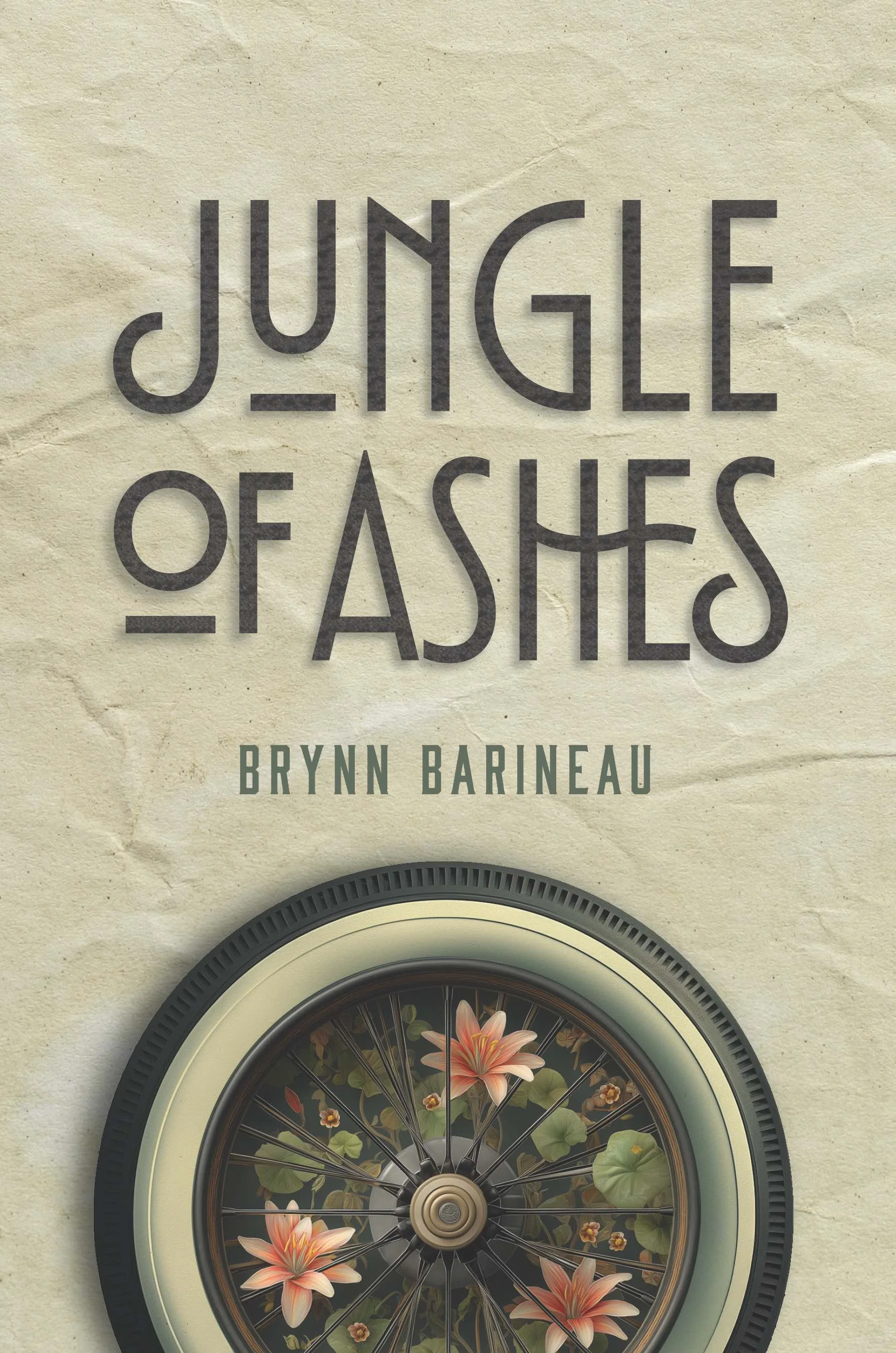
If this glimpse of Fordlandia and the Amazon has sparked your curiosity, continue the journey with Jungle of Ashes, a novel of ambition, resistance, and impossible love set in Henry Ford’s ill-fated rubber empire in the Amazon.