More Than a Panel: Why What’s New in Historical Fiction Matters
A panel often begins with simple things: a few faces on a screen, a stack of new books, a moderator ready with questions, and readers settling in to listen.
From the outside, that can look modest. Another event. Another hour on the calendar. Another set of titles to promote.
But literary conversations are rarely only that.
At their best, they become a kind of meeting ground. They give writers a chance to speak not only about what they made, but about what it took to make it. They give readers a way to move beyond a book jacket description and into the deeper questions that animate a story. And they remind everyone involved that historical fiction is not simply a marketplace category. It is a living community built on curiosity, empathy, research, imagination, and a shared love of the past.
That is why What’s New in Historical Fiction matters.
What began as one of History Through Fiction’s earliest efforts to expand our reach and grow our network has become something more enduring. Over time, the series has helped us welcome new readers, connect with authors across the genre, and create a recurring space for the kinds of conversations our audience genuinely cares about: books, craft, history, and the long path from idea to finished novel.
One of our earliest ways of building connection
When History Through Fiction was still finding its shape, What’s New in Historical Fiction was one of the first clear ways to widen the circle.
The series gave us a format that was generous and flexible. It allowed us to bring together several authors at once, introduce readers to a range of new books, and create an event that felt both accessible and substantial. In practical terms, it also helped us grow. Registrations brought new people into the orbit of History Through Fiction. Each author brought their own readership and network into the conversation. Over time, the series became one of the ways our community learned to recognize us—not simply as a place that talks about books, but as a place that creates meaningful opportunities around them.
The platform has changed along the way. What began on Crowdcast eventually shifted to Zoom through Eventbrite, which is now the home for our virtual events more broadly. But the deeper purpose has remained the same. The goal was never merely to host another online panel. It was to make room for an exchange that benefits everyone involved: readers, writers, and the literary ecosystem that connects them.
Why the series matters for authors
There is something quietly important about giving authors space to talk about their work in the company of peers.
A novel may take years to write. It may pass through research notebooks, false starts, revisions, periods of uncertainty, and long stretches of private labor before it ever reaches a reader’s hands. By the time a book is ready to be discussed publicly, the author has often spent an extraordinary amount of time carrying that work alone.
A panel like What’s New in Historical Fiction offers a different kind of moment. It allows writers to step briefly out of isolation and into conversation. They are not asked only to market a product. They are invited to reflect on the history behind the novel, the emotional stakes of the story, the choices that shaped its form, and the themes that link their work to broader currents in the genre.
That matters.
There is nothing more encouraging than giving an author room to speak about a book that required so much labor, patience, and faith. Especially in historical fiction—where research can be extensive and the imaginative burden is high—that recognition matters deeply. These conversations create a rare kind of affirmation. Writers get to hear one another think aloud. They get to feel the commonality of the work. They are reminded that the solitude of writing does not mean the work itself is solitary in meaning.
And for a press or literary platform, that kind of goodwill is not incidental. It strengthens relationships. It builds trust. It tells authors that History Through Fiction is not only interested in their books, but in the ideas, histories, and human effort behind them.
Why the series matters for readers
Readers benefit in a different, but equally meaningful, way.
Historical fiction readers are rarely looking only for plot. They are often looking for a richer encounter with the past: a neglected voice, a more intimate angle on a public event, a setting that opens into a new world, or a character whose private life reveals something larger about history itself.
A panel series helps readers discover exactly that.
It introduces them to books they may not have found on their own. It lets them hear authors speak about why a subject mattered to them, what questions drove the writing, and what tensions or revelations shaped the story. In doing so, it turns discovery into engagement. A reader does not simply hear that a novel exists. They begin to understand why it was written and what kind of history it is trying to recover, complicate, or illuminate.
That is one reason the conversations can feel so energizing. A single panel may move from one era to another, one continent to another, one kind of emotional world to another, yet the links between them begin to emerge. Readers start to hear how historical fiction connects ambition and identity, memory and silence, public life and private desire, spectacle and survival. Those patterns are part of what make the genre so rewarding.
Panels also give readers something rarer than promotion: context. They invite people into the thinking behind the books. And for an audience that genuinely loves history and literature, that context is not an extra. It is part of the pleasure.
Why historical fiction especially benefits from this kind of conversation
Every genre has its own rhythms, but historical fiction is especially well suited to panel conversation.
That is because historical fiction lives in tension. It is always balancing documented fact with imaginative reconstruction, public record with inner life, the large movements of history with the private decisions of individual people. Writers of historical fiction are constantly asking: Whose story has been overlooked? What does the archive preserve, and what does it fail to hold? How do we render another time honestly without flattening it into costume or cliché? How do we make readers feel both distance and nearness at once?
These are not small questions, and they do not disappear once the book is published.
A panel gives those questions room to breathe. It lets authors compare approaches, readers hear how different novels grapple with similar challenges, and the broader community witness the seriousness and creativity that the genre demands. In that way, What’s New in Historical Fiction becomes more than a showcase. It becomes a site of interpretation—a place where books are not only introduced, but situated within larger conversations about story, research, and historical imagination.
That is good for readers. It is good for writers. And it is good for the genre itself.
The latest panel is a strong example of what the series does best
The newest edition of What’s New in Historical Fiction offers a vivid example of why the series continues to matter.
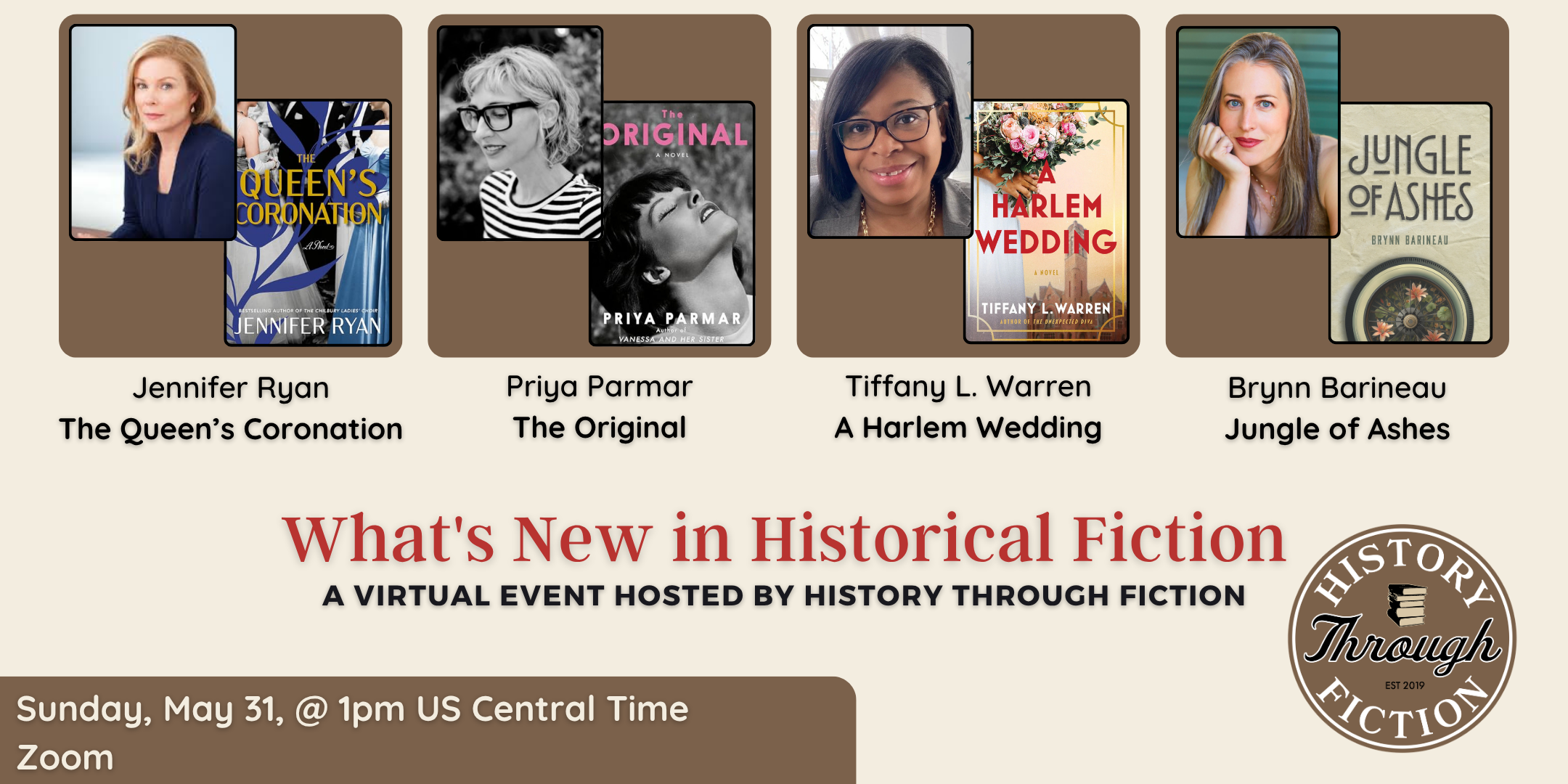
This panel brings together Tiffany L. Warren (A Harlem Wedding), Brynn Barineau (Jungle of Ashes), Priya Parmar (The Original), and Jennifer Ryan (The Queen’s Coronation), in a conversation moderated by Colin Mustful. On the surface, the novels range widely: Harlem in the 1920s, Fordlandia in the Brazilian rainforest, 1930s Hollywood, and the world surrounding Queen Elizabeth II’s coronation in 1953.
And yet that range is precisely the point.
Across these very different settings, the novels share an interest in the pressures placed on identity, the tension between public expectation and private desire, and the search for self-determination inside systems larger than any one person. One novel explores the emotional cost of life in the spotlight. Another looks at industrial ambition and cultural collision in the Amazon. Another examines reinvention, performance, and the risks of refusing convention. Another turns toward pageantry and power while tracing the quieter struggles unfolding behind the scenes.
This is what the series does so well. It makes diversity of setting and style feel coherent by revealing the deeper human questions the books hold in common. It invites readers not only to learn about four new novels, but to see how historical fiction can speak across periods, geographies, and social worlds.
Why we hope the series continues for years to come
For History Through Fiction, What’s New in Historical Fiction is no longer simply an experiment that worked. It is part of the shape of what we do.
It helps us grow our audience, yes. It helps us reach new readers through the authors who join us, yes. It strengthens our network and extends goodwill across the historical fiction community, yes.
But beyond all of that, it does something simpler and more meaningful: it creates a place where people who care about historical fiction can gather around the work itself.
That matters in a literary culture that often pushes everyone toward speed, fragmentation, and constant visibility. A thoughtful panel slows things down just enough for reflection. It reminds us that behind every new release is not only a publicity campaign, but years of thinking, reading, imagining, revising, and persisting. It reminds us that readers want more than announcements; they want insight, connection, and the chance to understand why a story matters. And it reminds us that writers need moments of celebration too.
We are proud of what What’s New in Historical Fiction has become.
We are proud of the readers it has introduced us to, the writers it has allowed us to support, and the conversations it has made possible. Most of all, we are proud that it continues to create space for what drew many of us to this field in the first place: the joy of discovering new stories, the thrill of recovering new histories, and the feeling that literature can still bring people into genuine conversation.
If you have joined us for a panel before, thank you for being part of that community. If you have not yet attended one, we hope you will keep an eye on the series, explore the featured books, and join us for a future conversation. Historical fiction is full of stories worth sharing. This series is one small but meaningful way to help them find their readers.
Want to hear about future panels, workshops, and special events as soon as they’re announced? Follow History Through Fiction on Eventbrite to get notified whenever a new event goes live.