
From Pamphlets to Podcasts: The History of the True Crime Genre, the Real Stories That Inspired It, and Why Our Culture Craves It
A Guest Blog Post by Megan Eesley
True crime has boomed into a modern spectacle, with hosts of podcasts, books, and television series dedicated to the genre. However, true crime as a genre is in no way new or modern. In fact, it dates all the way back to the 16th century. It has remained prevalent throughout the centuries due to the myriad of twisted cases that continue to spark horror across the world, with historic cases such as Jack the Ripper and the Black Dahlia continuing to spark thought, theory, and debate today. True crime has gained a cult-like following that has gained steam over the centuries due to the appeal of the macabre, our ability to relate to the victims, and our ability to see the darkest parts of human nature reflected in the perpetrators.
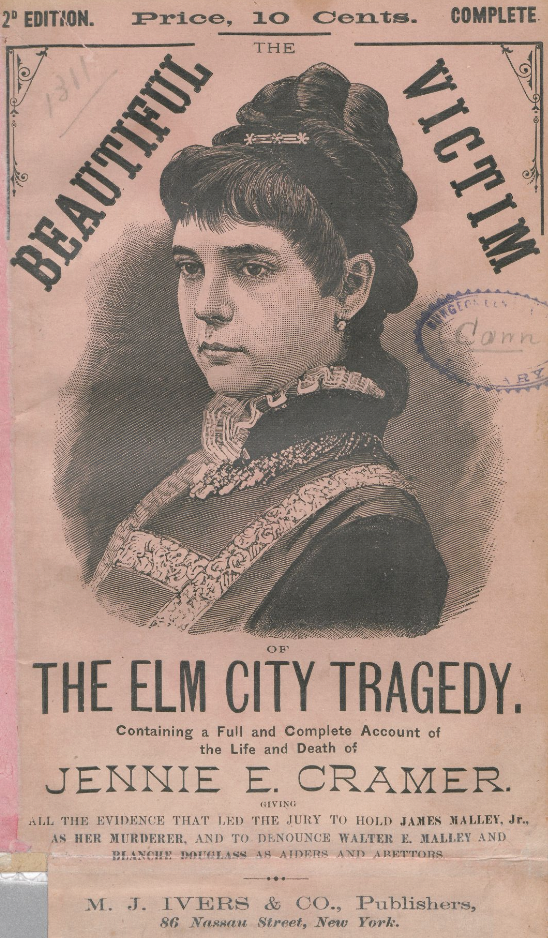
Cover image from The beautiful victim of the Elm City, a true crime pamphlet published in 1881 - https://collections.nlm.nih.gov/catalog/nlm:nlmuid-101480846-bk
Origins of the True Crime Genre
Between 1550 and the 1700s, pamphlets detailing true crimes (such as murders, robberies, and marital scandals), judicial proceedings, and even narrative ballads about crime circulated to inform the literate population of their nation and province. The ballads were often narrative and told from the criminal’s point of view, putting the reader in the shoes of the wrongdoer and asking them to understand their psyche. For example, one such ballad called “Last Goodnight” followed the Earle of Essex as he was sentenced to death and heading to the executioner’s block for the crime of treason. By following his last thoughts, the unnamed writer asks the reader to consider things from the perspective of the criminal and the guilt he carries. These stories were often illustrated within the pamphlets by woodcuts, creating visuals of complex and gruesome crimes.
Literary Journalism
As pamphlets grew out of style and were replaced by traditional newspapers, the practice of journalism was on the rise. And, as any journalist will tell you, there are just some stories that you cannot tell in eight hundred words or less. A movement called New Journalism was born in the 1960s and worked to combine intensive journalistic elements and research with narrative storytelling, taking true events and turning them into novel-length stories. One of the original pioneers of this genre is the book In Cold Blood by Truman Capote, published in 1966. Originally published in several news installments before the story was compiled into a book, it focused on the murders of the Clutter family in Kansas in 1959. The book was borne of over six years of researching the murders, and blended his 8,000 pages of notes with narrative writing, switching between the points of view of the killers, the victims, and other people caught within the ripples of the crime. In Cold Blood created the groundwork for the modern true crime genre, blending both fact and narrative storytelling that we see in true crime media today.
True Crime Television Series and Podcasts
As televisions entered households and streaming services took hold of our attention, the true crime genre bought time on the air. Shows like Dateline took true crime stories and fit them into one-hour segments, using security-cam footage, crime-scene photographs, and interviews to bring the stories to life on the screen. The series used tense narration and music to rouse anxiety in their audience and draw them into the story, keeping them on the edge of their seat with every cliffhanger before the commercial breaks. Then, as people leaned into the narration and storytelling of true crime, other series joined the scene, omitting the omniscient narrator, crime-scene stills, and detective interviews in favor of traditional film style and techniques. They created sensationalist entertainment based on true stories, such as Monster: The Ed Gein Story, the series which focused on an American serial killer, detailing not only his murders but also his life struggles leading up to his crimes, giving audiences the opportunity to have a deeper understanding of the killer.
Popular true crime podcasts like Crime Junkie bring listeners into the action by making listeners into investigators.
Then, as podcast streaming platforms grew in popularity and people sought to consume media with ease while engaging in other tasks, such as working in isolation in quarantine, true crime podcasts took over the scene. Spotify and Apple Podcasts made it easy for people to create and upload their own podcasts with little cost or specialty equipment, meaning that true crime enthusiasts were able to research and share their findings about cases that interested them. This created a plethora of niche series for consumers to engage with, including unsolved cases, Victorian crimes, women perpetrators, and more. Popular true crime podcasts include Crime Junkie Podcast, Serial Killers and Murderous Minds, and Murder in America. This transformed the true crime scene because it blurred the line between producer and audience; the audience who enjoyed the genre became the producers of the stories. Now, people did not have to live vicariously through the interviews of the investigators; suddenly they were the investigators sharing their findings. This gave the people the ability to claim the genre as their own and make their own mark upon it, to rely upon their own research, rather than being dependent on others to do the fact-finding for them.
Stories that Define True Crime
Ratcliffe Highway Murders
Each genre has its own canon literature that defines it, and the same holds true for true crime. Although it is not often discussed anymore, the first true crime story that put a heavy mark on the public mind was the Ratcliffe Highway Murders of 1811. Seven people were viciously killed in the East End of London, seemingly randomly, which launched a public mania, with many people afraid that they will be the killer’s next target. The terror from the murders ran through London, prompting some of the residents to abandon the city entirely. Even Londoners who were outside of the city at the time of the murders reported being struck with fear and being unwilling to return to their homes. A man named John Williams became a main suspect in the case when he was seen returning to his lodgings at the Pear Tree Inn shortly after the murders in torn and bloody clothes. The police determined that he had opportunity, access to the potential murder weapon, and no clear alibi for the time of the murders, and he was arrested. While in prison, he committed suicide, which was widely seen as an admission of guilt. After he died, the courts ruled that he was guilty of the crimes and he was named the murderer, offering the country peace of mind that he was off the streets.
Jack the Ripper
Possibly the most notorious case that is still highly researched and debated today is that of the infamous Jack the Ripper. Jack the Ripper targeted and killed five sex workers in Whitechapel in 1888, brutally mutilating their bodies, removing internal organs, and even skinning one of his victims. The way that their bodies were ripped apart after their death indicated that Jack the Ripper may have had surgical knowledge, indicating that he may have been a butcher or a doctor. The theory that he could have been a doctor meant that the killer could have been among the educated and respected class, which caused a commotion among higher-class members, because although he was targeting women in lower social circles, the rich could have been brushing elbows with the killer in their day-to-day lives. The theories and suspicion of the upper class grew, fingers pointing everywhere until even Prince Albert stood accused by some members of the public of being Jack the Ripper. Today, the killer’s identity is still unknown.
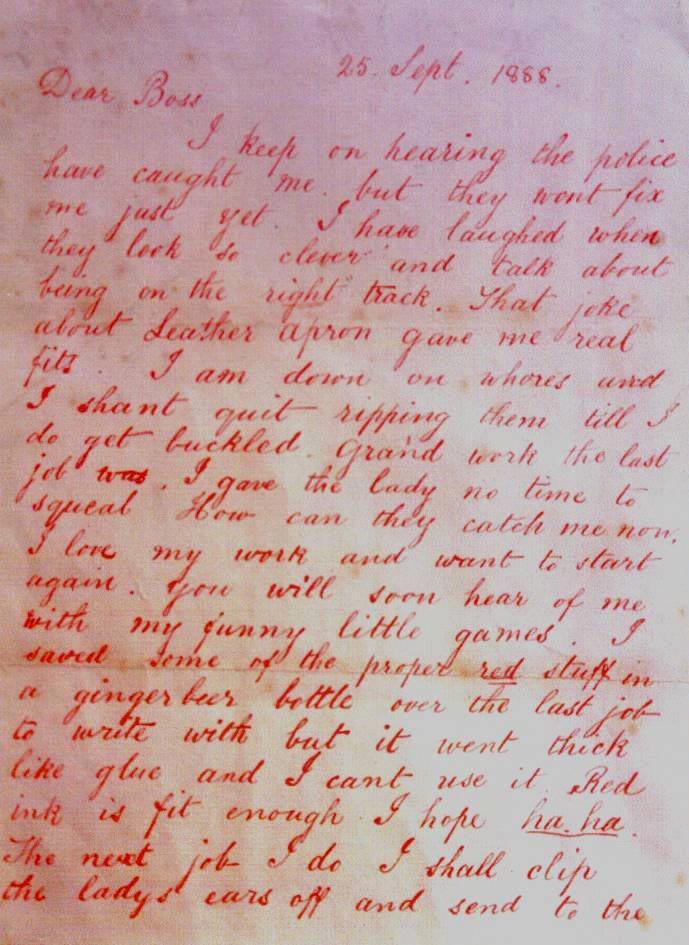
Jack the Ripper’s “Dear Boss” letter mocked the London news media for not being able to discover his identity - https://en.wikipedia.org/wiki/Dear_Boss_letter
One of the main intrigues of this case is the letters believed to be sent by Jack the Ripper to the police and media, taunting them. The most famous of these letters is the “Dear Boss” letter sent to the news media in London, mocking them for not being able to discover his identity. Although the authenticity of this letter is widely debated, there is one that is considered to be genuine correspondence from the killer: the “From Hell” letter. But what sets this letter apart from all the others? It contained half of a human kidney, which could have belonged to one of the victims. Within the contents of the letter, Jack the Ripper ridiculed investigative efforts and claimed to have eaten the other half of the kidney.
The gruesomeness of the murders, terror struck by the alleged letters from the killer, and the inability to know his true identity has caused this case to be one of the most archetypal cases of true crime. It has inspired multiple books and television series dedicated to uncovering the true identity of the killer centuries after the crimes.
The Black Dahlia
One of the most famous unsolved true crime cases to happen on American soil is that of the Black Dahlia. Aspiring Hollywood star Elizabeth Short was found sliced in half at the waist on January 15, 1947. Her body was drained of blood, but there was no blood found at the crime scene, indicating that she had been killed elsewhere and then transported after the murder. Her picture was posted in the local news, asking for anyone who may have information regarding her leading up to her death to share what they knew to help find her killer. However, the police were mainly contacted by publicity seekers, making many of the leads they were given fruitless.
Letters sent from her supposed murderer, whose identity remains unclear today, taunted the Los Angeles Examiner. A package was sent to the Los Angeles Examiner covered in gasoline, filled with documents pertaining to Elizabeth Short, including pictures and her birth certificate. Another letter signed off from the “Black Dahlia Avenger” said that the killer grew bored and would turn themselves in to the police. However, he did not show up at the station, and sent another letter to the local newspaper: “Have changed my mind. You would not give me a square deal. Dahlia killing was justified.” After the Black Dahlia Avenger letters became known to the public, many people sent in letters penned with the same name, causing the authenticity of every letter received to be put into speculation, but also showing that both the fear and adrenaline of the crime was prominent in the public mind. To this day, many people still wonder as to the killer’s identity and motivation for killing Elizabeth Short. This murder was one of the first large true crime cases of the twentieth century in the United States, and the pulse it sent through the public initiated an interest and fanaticism throughout the country that grew throughout the century.
The Cultural Obsession
How can there be such an international cult following for a genre that follows the true stories of the darkest depths of humanity and its capabilities? Is it the allure of the macabre, the fact that we can see ourselves projected on the victims, or that we can see the darkest parts of ourselves reflected in the offenders? Perhaps it is a mix of the three answers.
People crave sensationalism, plain and simple. Having something real and being able to turn it into a spectacle allows them to find intrigue in the world around them, to try their hand at cracking a case, and to understand the motivations of the criminal. Additionally, fear is one of the quickest ways to get an adrenaline rush, to feel one’s brain moving quickly, to adjust to new stimuli, and take the monotony out of everyday life. Being able to turn to true crime stories allows one to get that rush of terror and intrigue.
Many people can see themselves within the victims of these true crime stories. A common theme within true crime is that anyone can be the victim of the story. It does not matter if they are isolated or have a strong friend group, rich or poor, significant in the public eye or a regular person, these crimes can happen to anyone. So, it is easy for readers to put themselves within the perspective of the victim. Additionally, many women cite that they engage in true crime media as a form of safety education since there is a high likelihood of a woman being the victim of a violent crime. They study true crime to understand what was the point of no return for the victims, what could have been done differently, and learn how they can protect themselves from similar crimes.
Finally, there is the idea that we can see the darkest parts of humanity—and even ourselves—reflected within the perpetrators. The true crime genre shows us how thin the veil is between moral law-abiding citizens and the offenders within these crimes. Sometimes it is something small that sends a criminal over the edge, or the piling of small reasons growing over time until they snap, and can leave us wondering, “What could be the thing that would make me snap?” Many of the perpetrators are well-known and well-liked. They are friends, family members, coworkers, even respected members of society. Just as the victim can be anyone, the villain can be any one of us.
The Real Meaning of True Crime
True crime has always been more than a catalogue of grisly events. It is also a history of how societies interpret fear, morality, justice, and storytelling. As you read, consider not only why these cases have endured, but also what it means to turn real suffering into narrative—and why those stories continue to command our attention.
Megan Eesley is an American writer with her M.A. in English.
