Margaret Morgan: The Forgotten Woman Behind a Landmark Supreme Court Case
When discussing the legal history of slavery in the United States, names such as Dred Scott v. Sandford or the Fugitive Slave Act of 1850 often dominate the conversation. Less familiar is Prigg v. Pennsylvania (1842), a Supreme Court decision that fundamentally altered the relationship between federal and state authority over the recapture of people claimed as fugitives from enslavement. Yet at the centre of this constitutional dispute was a woman whose name rarely appears in legal histories: Margaret Morgan.
Morgan’s story illustrates how the lives of ordinary individuals could become entangled in questions of constitutional law, with consequences that extended far beyond their own circumstances.
Living Between Enslavement and Freedom
Margaret Morgan was born enslaved in Maryland in the early nineteenth century. Although she had been permitted to live independently for many years, she had never been formally manumitted. This distinction, seemingly administrative, would ultimately determine the course of her life.
Around 1832, Margaret, her husband Jerry Morgan—a free Black man—and their children moved to York County, Pennsylvania. As a free state, Pennsylvania offered opportunities unavailable in Maryland, and the family established a life there believing themselves to be beyond the immediate reach of enslavement.
Their sense of security proved fragile.
A Test of Pennsylvania’s Personal Liberty Laws
Following the death of the man who had claimed ownership of Margaret, his heirs sought to reclaim her as property. In 1837, Margaret Ashmore employed Edward Prigg, a professional slave catcher, to recover Morgan and return her to Maryland.
Pennsylvania had attempted to curb the growing problem of free Black people being kidnapped and unlawfully claimed through its Personal Liberty Law of 1826. Under this legislation, anyone claiming that an individual was a fugitive from enslavement was required to present the case before a Pennsylvania judge before removing them from the state.
When a local magistrate refused to issue the necessary certificate, Prigg ignored the decision. Margaret Morgan and several of her children were seized and forcibly transported back to Maryland without judicial approval. Her husband was left behind.
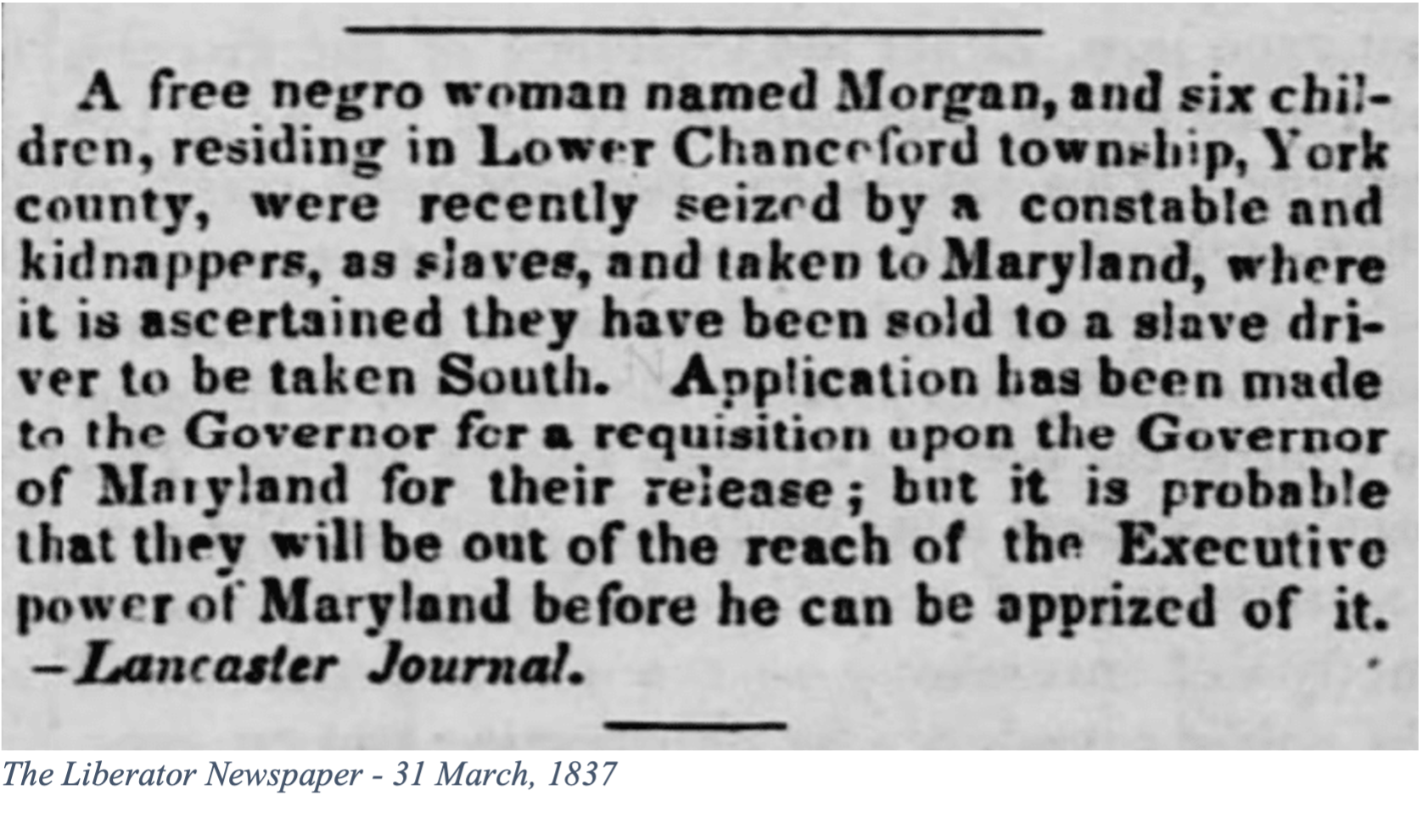
After this point, Margaret largely disappears from the historical record. Most historians believe she and her children were sold into the Deep South, although surviving documentation has not confirmed their ultimate fate. The absence of records serves as a reminder of how easily the lives of enslaved and formerly enslaved people could disappear from the archive.
From Criminal Prosecution to Constitutional Crisis
Pennsylvania responded by prosecuting Edward Prigg under its anti-kidnapping legislation. The case soon evolved beyond a question of whether Prigg had violated state law. Instead, it became a constitutional dispute over the balance of power between individual states and the federal government.
Prigg argued that Pennsylvania’s Personal Liberty Law conflicted with the Fugitive Slave Clause of the United States Constitution and the federal Fugitive Slave Act of 1793. The dispute ultimately reached the Supreme Court in 1842.
Writing for the majority, Justice Joseph Story held that the recovery of people alleged to have escaped enslavement fell primarily under federal jurisdiction. Because Pennsylvania’s legislation imposed additional legal requirements on slaveholders seeking the return of people they claimed as enslaved, the Court ruled that those provisions were unconstitutional.
The judgment overturned Prigg’s conviction and significantly limited the ability of individual states to regulate the capture and removal of people alleged to have escaped enslavement.
A Decision with Lasting Consequences
At first glance, Prigg v. Pennsylvania appeared to strengthen the position of slaveholders. By establishing federal supremacy in matters relating to the recapture of people claimed as fugitives from enslavement, the Court restricted the capacity of free states to create legal barriers against their removal.
However, the decision also produced an unexpected consequence. Justice Story concluded that while states could not obstruct the enforcement of federal law, they were not obliged to enforce it themselves.
Northern states quickly recognised the significance of this distinction. Rather than assisting slave catchers, many enacted new Personal Liberty Laws that prohibited state officials from participating in the capture or detention of people claimed as fugitives from enslavement. Although these measures did not prevent the enforcement of federal law, they reflected growing resistance to the expansion of slavery and intensified sectional tensions during the 1840s.
The principles discussed in Prigg also influenced later constitutional debates concerning the relationship between state and federal authority. While the context has changed dramatically since 1842, the case continues to be referenced in discussions surrounding the limits of federal power.
Why Has Margaret Morgan Been Forgotten?
Despite the significance of the case, Margaret Morgan herself occupies only a small place in many accounts of American legal history. This is partly because the surviving historical record is fragmentary. Unlike the judges, lawyers and politicians involved in Prigg v. Pennsylvania, Morgan left behind no letters, diaries, or personal testimony. What historians know about her comes largely from court records, newspaper reports, and the legal documents generated by the case itself.
There is also a broader pattern at work. Traditional legal histories have often prioritised judicial reasoning over the lived experiences of the individuals whose cases reached the courts. As a result, names such as Joseph Story and Edward Prigg are widely recognised by legal scholars, while Margaret Morgan’s experiences are frequently reduced to a brief reference within the background of the case.
In recent decades, historians have sought to recover the stories of those whose lives shaped major legal and political developments but whose voices were largely absent from the documentary record. By placing Margaret Morgan at the center of Prigg v. Pennsylvania, historians have highlighted that constitutional history is not solely a story of judges and legal principles. It is also a history of families, communities and individuals whose lives were irrevocably altered by the law.
Remembering Margaret Morgan
Prigg v. Pennsylvania remains one of the most consequential Supreme Court decisions issued before the American Civil War, shaping the constitutional relationship between federal and state authority while exposing how precarious freedom remained for Black Americans in the antebellum United States.
Remembering Margaret Morgan does not diminish the legal importance of the case; rather, it restores the human story that lay behind it. Her experience demonstrates that constitutional law was never merely an abstract debate conducted in courtrooms. Its interpretation determined whether families remained together or were torn apart, whether freedom could be defended, and whose voices would be preserved in the historical record.
Recovering Margaret Morgan’s story allows us to understand Prigg v. Pennsylvania not only as a landmark constitutional decision, but also as a reminder that the law’s most enduring consequences were often borne by those who rarely had the opportunity to speak for themselves.

About the Author
Grace E. Turton is a historian, founder of Heritage Now, Acquisitions Reader, and Historical Content Specialist for History Through Fiction. She holds an MA in Social History and a BA in History & Media from Leeds Beckett University. Through her work with History Through Fiction and Heritage Now, Grace conducts historical research, prepares reports for forthcoming novels, supports authors through the writing process, and helps ensure historical accuracy across fiction, nonfiction, journal articles, and podcasts. She specializes in British and Italian history but has a broad interest in global history and is passionate about preserving the past through rigorous research and compelling storytelling. Outside of her professional work, Grace enjoys exploring the Yorkshire Dales with her dog, Bear, watching classic films, and playing rugby league.
Continue Margaret Morgan’s Story Through Historical Fiction
The story of Margaret Morgan reminds us that history is not only shaped by landmark court decisions, but by the lives of the people who endured their consequences. Behind every legal battle are individuals and families whose struggles, choices, and hopes reveal the human impact of the past.
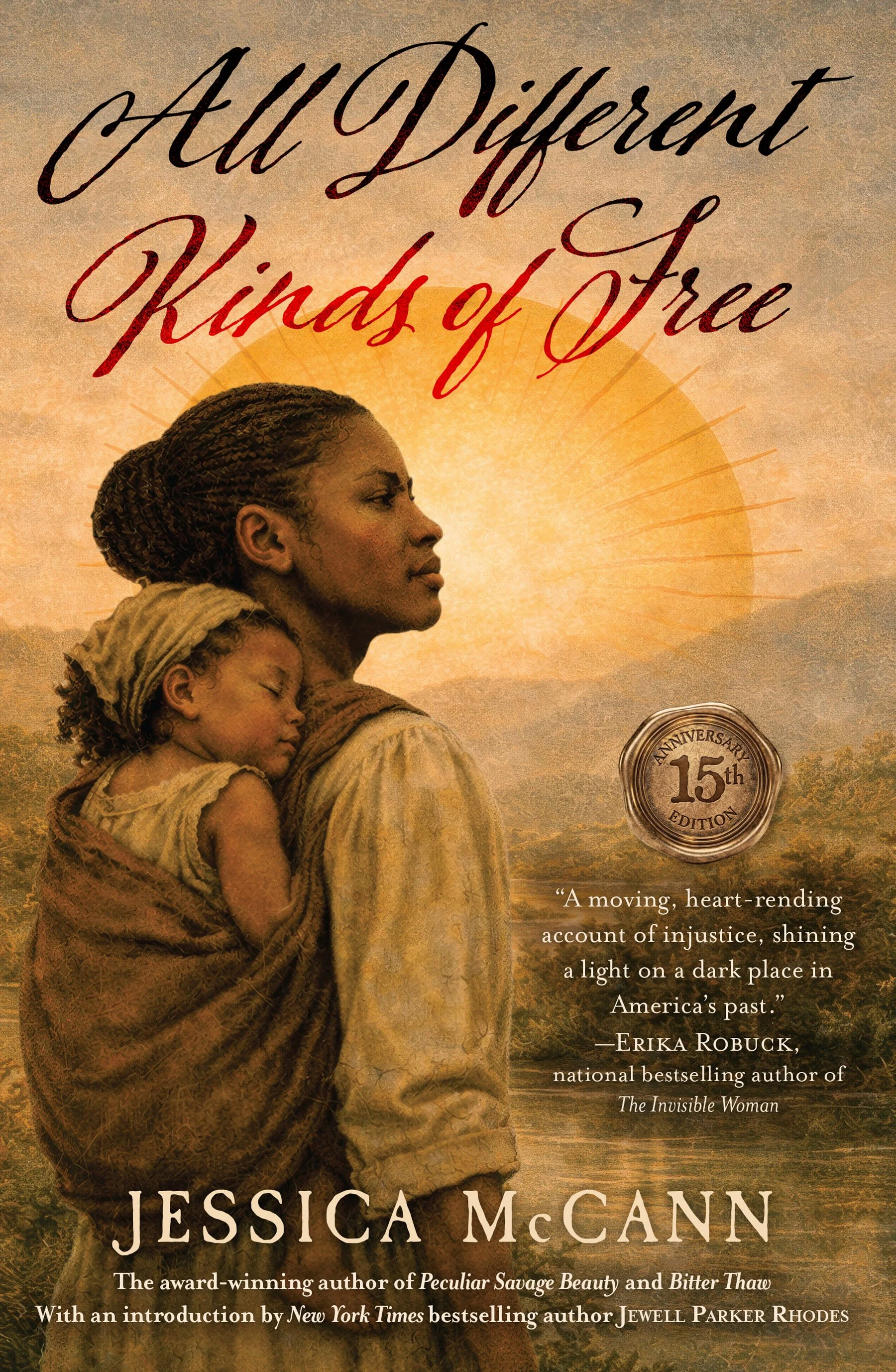
For readers interested in exploring the complex realities of freedom, slavery, and resistance in nineteenth-century America, Jessica McCann’s All Different Kinds of Free brings these themes to life through the story of a woman fighting for liberty in a nation divided by slavery.
Discover this powerful work of historical fiction and continue exploring the untold stories of those who challenged injustice.
Purchase your copy of All Different Kinds of Free from the History Through Fiction Store today.