
Book Feature: After Appomattox by Diane Green
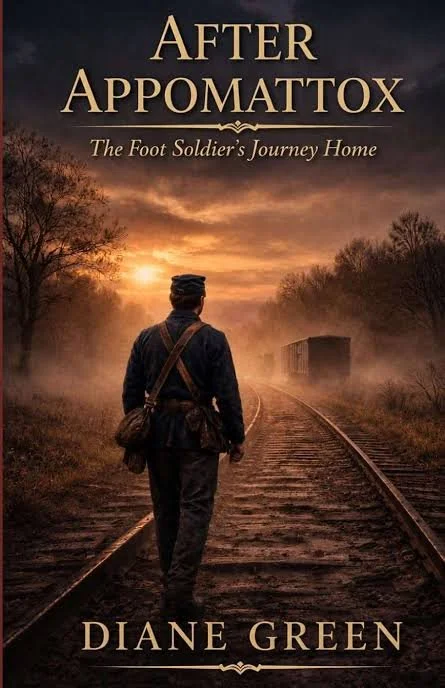
After Appomattox: The Foot Soldier’s Journey Home follows Nathan Nelson Campbell, a Union soldier in the 10th New Jersey Volunteer Infantry, through the final days of the Civil War and the difficult journey back to ordinary life.
Captured in the closing weeks of the war, packed into a Confederate boxcar, and released after Lee’s surrender, Nathan expects at last to turn north toward New Jersey. Instead, he and his regiment are ordered south again, marching hundreds of miles through Virginia toward North Carolina in the uncertain aftermath of Appomattox.
But war does not end simply because the guns fall silent.
Nathan carries memories of battle, the death of his brother John Robert, the suffering of soldiers on both sides, and the moral burden of a war fought by deeply religious men who prayed to a merciful God while doing terrible things in His sight. Yet his journey is not sorrow alone. Along the road there are moments of humor, tenderness, beauty, companionship, and unexpected hope: a proud recruit humbled by his first encounter with the enemy, a nurse whose gentle care reminds Nathan that he is still a man, and a field of dandelions that awakens the farmer in him and suggests that even the smallest seeds can carry life forward.
Through ruined cities, punishing marches, the great Victory Parade in Washington, and the long-awaited return to his family farm, Nathan must discover what it means not merely to survive, but to come home changed.
Inspired by documented family history and military records, After Appomattox is a moving work of historical fiction about war and peace, grief and laughter, faith and memory, and the courage required to begin again.

Diane Green is a multi–award–winning author whose work blends nostalgic Americana, gentle humor, historical fiction, and heartfelt Christmas storytelling. Her books—many of them short, carefully crafted works—have received Second Place honors in national literary competitions, including Story Monsters’ Royal Dragonfly Book Awards in Holiday and Children’s Chapter Book categories.
Before turning to fiction, Diane worked in academia on NEH-funded historical editing projects and later as a researcher for executive search firms in New York and Florida. Her deep appreciation for history, community, and the quiet heroism of ordinary lives informs much of her storytelling.
Whether writing about small-town Christmases, Revolutionary-era intrigue, eccentric dreamers, or reflective family memories, Diane’s stories are marked by warmth, wit, and an enduring belief in redemption.
She writes from her current home in Florida, carrying with her the spirit of her New England years and drawing inspiration from the landscapes, histories, and communities of both regions.
A Blog Interview with Diane Green
1. Most Civil War novels end at Appomattox. What inspired you to begin there instead?
Appomattox ended the fighting for one army, but it did not instantly end the war for the men who had survived it. Nathan Campbell and the 10th New Jersey did not simply turn north and go home. They were ordered south toward Danville, then marched back through Virginia to Washington before they were finally released. I became fascinated by that overlooked space between surrender and homecoming, the moment when victory had been declared, but peace had not yet become real.
2. Nathan's greatest challenge isn't surviving the war, it's coming home. Why did that journey matter most to you?
Survival is not the same as restoration. Nathan had learned how to endure battle, captivity, exhaustion, and loss, but returning home required a different kind of courage. He had to live among people who loved him while carrying memories they could not fully understand. I wanted to explore whether a man who had spent years giving everything to war could still find enough courage for work, family, grief, love, and peace.
3. Your novel is inspired by documented family history. How did your research shape Nathan's story?
Nathan Nelson Campbell was my great-great-grandfather, and his documented service with the 10th New Jersey Infantry gave the novel its historical foundation. Military records revealed that he served for four years, was wounded and captured, and continued marching after Appomattox. My family also preserved his Grand Army of the Republic service poster, which made him feel less like a name in a record and more like a man whose experiences continued to matter across generations. Where the records were silent, I used historically plausible details to imagine his thoughts, relationships, and final journey home.
4. Faith and forgiveness are woven throughout the novel. Why were those themes important to explore?
The Civil War was fought by people who often carried Bibles, prayed before battle, and believed deeply in God, yet they were also asked to kill and endure terrible suffering. That contradiction interested me. The verse from Mark 8:37, “What shall a man give in exchange for his soul?”—became the moral question beneath Nathan’s journey. His faith is shown less through speeches than through his growing recognition of the humanity of former enemies, freed people, and everyone wounded by the war. Forgiveness does not erase what happened, but it allows him to choose what kind of man he will become afterward.
5. What do you hope readers carry with them after they finish After Appomattox?
I hope readers remember that history does not end when the battle ends. The consequences continue in families, memories, communities, and generations. I also hope they carry Nathan’s quiet belief that healing happens one step at a time, not through grand declarations, but through work, compassion, remembrance, and the willingness to walk toward the light even while carrying grief.