
Killing Your Darlings, Circus Style
“Kill your darlings.” Every novelist hears this advice and good authors heed it. Darlings, those scenes you thrilled to write but in retrospect have no place in your story. Darlings, whole chapters that do nothing to advance the plot or develop the characters. Darlings, those clever turns of phrase, those bursts of purple prose, those complex metaphors. They are all darlings. And they all deserve to die.
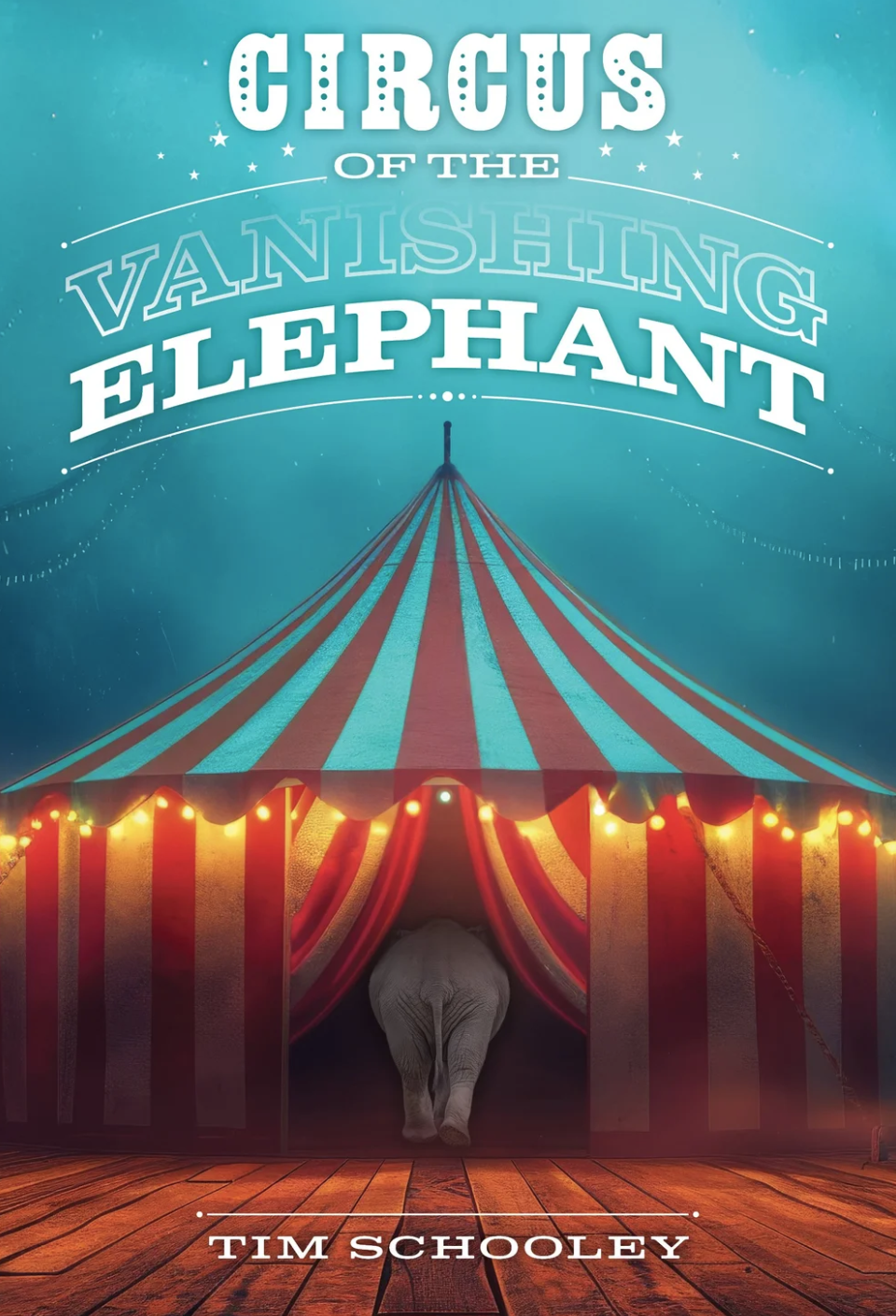
But, as I discovered, that advice is easier said than done when you’re writing about a circus. My newest novel, Circus of the Vanishing Elephant, derives loosely from my own experience of working as a clown with Ringling Bros. and Barnum & Bailey Circus in the late 1970s. The novel is historical fiction and adventure, it is not memoir or autobiography, and I labored to invent a story and characters that are both odd and quirky but not based directly on my own life. Still, scenes crept in from my own experience, and it took me some time to acknowledge that although those scenes might be fun, they were nonetheless darlings that had to die.
In the first draft of my novel, I had one of my main characters, Ainge, a circus clown, help put clown makeup on renowned gay rights activist Harvey Milk. Like Ainge, I too helped put clown makeup on Harvey Milk when he appeared as a “guest clown” at Ringling Bros. in 1978 at the Cow Palace, just south of San Francisco. At the time, Harvey was on the San Francisco Board of Supervisors. My colleague, a clown named Richard Fick, asked me to help get Harvey made up as a clown and to perform a guest clown skit with him. It turned out that Harvey loved clowns and thrilled at the prospect of appearing as a clown in the Big Show, as Ringling Bros. was sometimes called. Tragically, Harvey was assassinated a few months later.
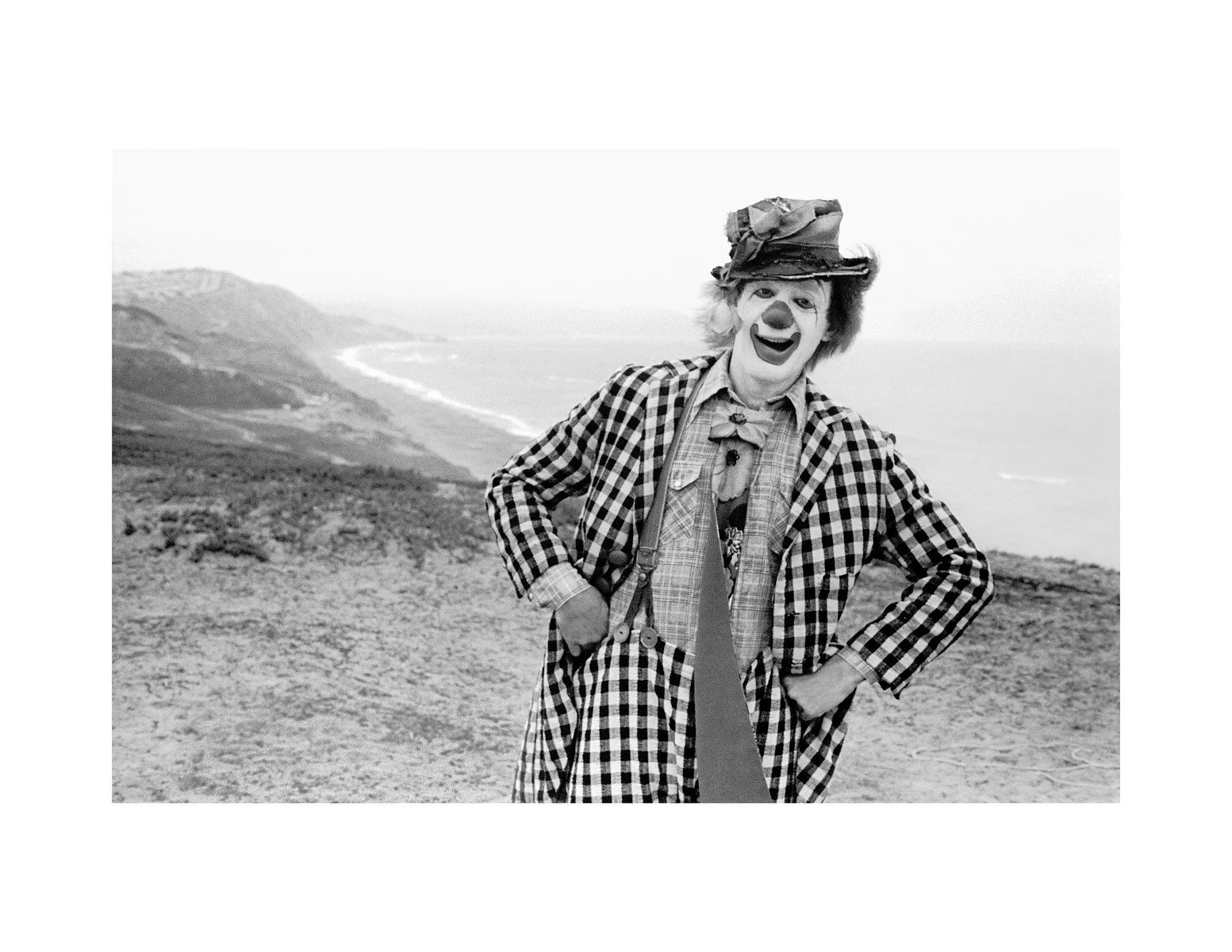
Even though I grew up in the San Francisco Bay Area, I had no idea at the time who Harvey Milk was. I remember asking him what he did for a living. When he replied that he was on the San Francisco Board of Supervisors, I also remember asking him what that was. (Give me a break, I was only seventeen; I turned eighteen that year while still working for the circus.)
While writing my novel, I thought this was a great set piece that I had to include in the story. One of my characters, Ainge, is young and unworldly, so I spiced the story up a little by having him ask Harvey, “What’s a board of supreme advisors?” It was during the process of polishing that first draft that I regretfully realized the scene had no place in the novel. It didn’t advance the plot; indeed, it brought the pacing to a bit of a halt; and it didn’t do enough to develop Ainge’s character to warrant keeping it around. It was a darling, and it had to go.
The other darling that succumbed involved one of the stories that I most enjoy telling about my life in the circus. One of the circus headliners was a tiger trainer named Charly Baumann. (Ringling Bros. had two traveling shows—the Red and the Blue—Charly Baumann was the star big cat trainer on the Blue Show, where I worked; Gunther Gebel-Williams was the star animal trainer on the Red Show.) Charly served both as tiger trainer and performance director, and he scared the hell out of me. It didn’t help that Charly rarely said the word “clown” without the preceding adjective, “f***ing.” It was only years later, after I’d left the circus and graduated from law school and was working as a lawyer in Oakland, that Charly and I became friendly. I think it helped him that I was no longer an effing clown.
Every performance of Ringling Bros. began with a parade of performers and animals around the three rings of the circus along the “track,” a walkway around the rings. The circus loved to doll up its performers, so it had the clowns and dancers (then called “showgirls”) wear gorgeous sequin-covered costumes for the opening number. My performance costume came covered from head to toe in red sequins.
In the opening parade of performers, I was the second person to enter the arena. I carried a colorful sign that read, “&.” Preceding me was a sequin-covered clown carrying a sign reading, “Ringling Bros.,” and after me came two clowns carrying signs reading “Barnum” and “Bailey.” I was the ampersand guy. As assigned, we led the parade around the circus track but then stopped front and center on the track as the other performers and many of the animals paraded past us.
This task required us to stop directly in front of the tiger cage. Tiger cages operate differently than as popularly portrayed in the media. They are not made of solid bars, but rather of crisscrossing wire that resides inside the center ring curb until lifted mechanically to form a barrier surrounding the circus ring. In other words, the cage gives a bit when pushed on. And the tigers inside the cage can reach through the interwoven wires of the cage.
Still, for eight months, the other clown banner-bearers and I dutifully stood in front of the tiger cage, holding our signs in the opening number, with our backs to the nearby tiger cage, even as the tiger handlers allowed the tigers to enter the cage prior to Charly Baumann’s tiger act. This had become so commonplace that none of the three other clowns or I gave any thought to the tigers as we stood with our circus banners, me with my somewhat pathetic “&” sign, until the end of the opening number. Until Los Angeles.
Did I mention that the end of the opening number involved the circus’s twenty or so elephants charging into the arena, around the track, and then stopping in front of me and the three other clowns as we stood at attention, holding our banners? The elephants would perform a “long mount” in front of us, which meant each elephant raised her front legs to put them on the rump of the elephant in front of her, creating what looked like an elephantine conga line. Again, we’d been performing this act for eight months before we got to Los Angeles, and we banner-bearers paid little mind to the fact that we were, for a few moments at the start of each show, sandwiched between a line of elephants and a cage of tigers. Until Los Angeles.
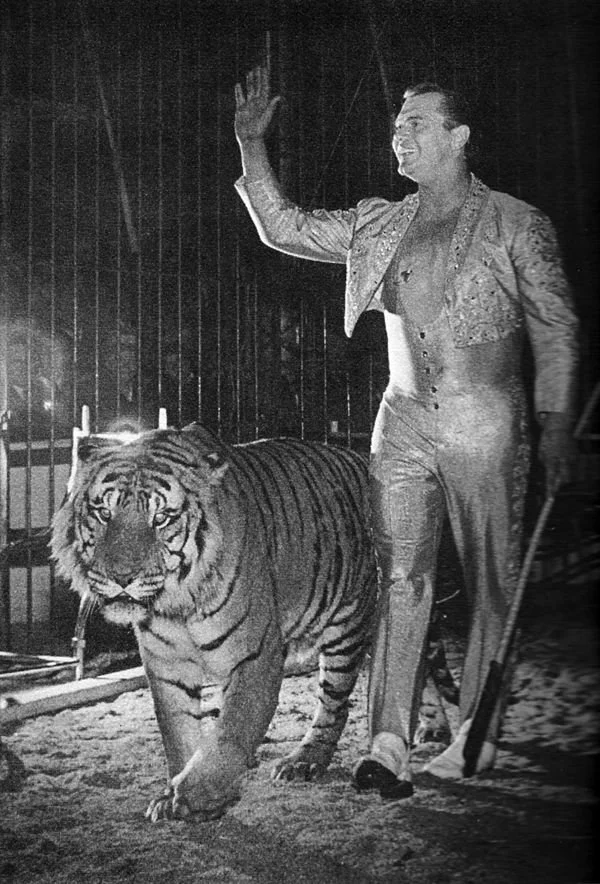
One day in LA, the circus band played the musical cue to start the show. One of my fellow clowns took the cue and entered the arena carrying his sequin-covered, “Ringling Bros.” banner onto the track, with me following with my “&” sign. We walked around the track and took up our positions front and center before the tiger cage. As the other circus performers—some leading horses, llamas, or camels—paraded in front of us, the tiger handlers allowed their charges into the tiger cage, one at a time.
I vaguely remember one of the other banner-bearers, Joe “Hollywood” Myer, joking around with me. Just another day at the circus. And then I felt Joe tug on my costume’s shoulder pad. I turned my head to see what he was up to and instead of his makeup-covered face, I looked directly into the eyes of a snarling tiger. The tiger had grabbed my costume and was trying to pull me into the cage. A tiger handler saw what was happening and smacked the tiger on the arm with a pole, which caused the tiger to let go of me. But the tiger had the presence of mind to grab my banner, which he managed to pull through the interwoven wires of the tiger cage.
The next few moments were a blur. Joe kept me from passing out. The circus band stopped playing, which almost never happens, because the band leader knew the next musical cue was for the elephants to charge into the arena and he didn’t want them to freak out upon seeing a tiger freaking out. Charly Baumann had to enter the tiger cage to rescue my poor “&” sign from a tiger reluctant to give up its prize. And then, of course, the music started up again and the show went on.
A darling. I included this scene in the first draft of my novel. And, because it had no place in the novel’s plot or in characterization, I killed it. Sometimes that murder hurts the writer more than it hurts the darling victim.

About Tim Schooley
Tim Schooley’s first job out of high school was as a circus clown with Ringling Bros. & Barnum & Bailey Circus. He later attended UC Santa Barbara and then UC Berkeley Law School. He worked as an appellate lawyer, taught at UC Davis Law School, and served as the managing attorney of the California Court of Appeal, Third Appellate District, in Sacramento.
All along, Tim wrote fiction, but he waited until his retirement to publish his debut novel, The Wool Translator. His forthcoming novel is Circus of the Vanishing Elephant.
Tim is active in the Sacramento literary community, serving as Co-Chair of the Sacramento Book Festival and on the board of directors of the Sacramento branch of the California Writers Club.