
Rags of Time: Michael Ward’s Mystery in 17th-Century London
If I asked you to think about English history, in particular the Stuart period, what would come to mind?
The English Civil War? Or, perhaps 1666, the terrible year of plague and London’s devastating fire? Or the execution of King Charles, and Cromwell’s Commonwealth that followed?
It’s little wonder this period is known for its political and religious upheaval, and this was uppermost in my mind when I started researching Stuart England. I soon realized that indeed it was a period of change, but of an order and magnitude I had scarcely imagined.
In just twenty extraordinary years, from 1640 to 1660, England not only experienced civil war, regicide, a republic and the restoration of monarchy, but also a series of developments in science, medicine, and mathematics which can be easily overlooked amidst the political and military tumult.
More significantly, these movements did not occur in isolation. Look a little closer and it’s possible to detect symbiotic relationships emerging between the day-to-day realities of politics, religion and commerce, and the new world of empirical research that fostered both a spirit of discovery and propelled London into a new position of international significance.
Merchant trade lay at the heart of this growth, aided by a profusion of scientific advances, in astrology, lens technology, the discovery of terrestrial magnetism (explaining why compass needles pointed north) and the introduction of logarithms to simplify navigational calculations.
Merchants were taking to the seas and travelling further in increasing numbers, encouraged and enabled by these developments; and they were not alone. From the late 1620s to the early 1640s, some 80,000 people sailed from England’s shores, with up to 60,000 crossing the Atlantic, an enormous figure for that time. A significant number of these emigrants were Puritans, wishing to found a New World where they could practice their religion freely.
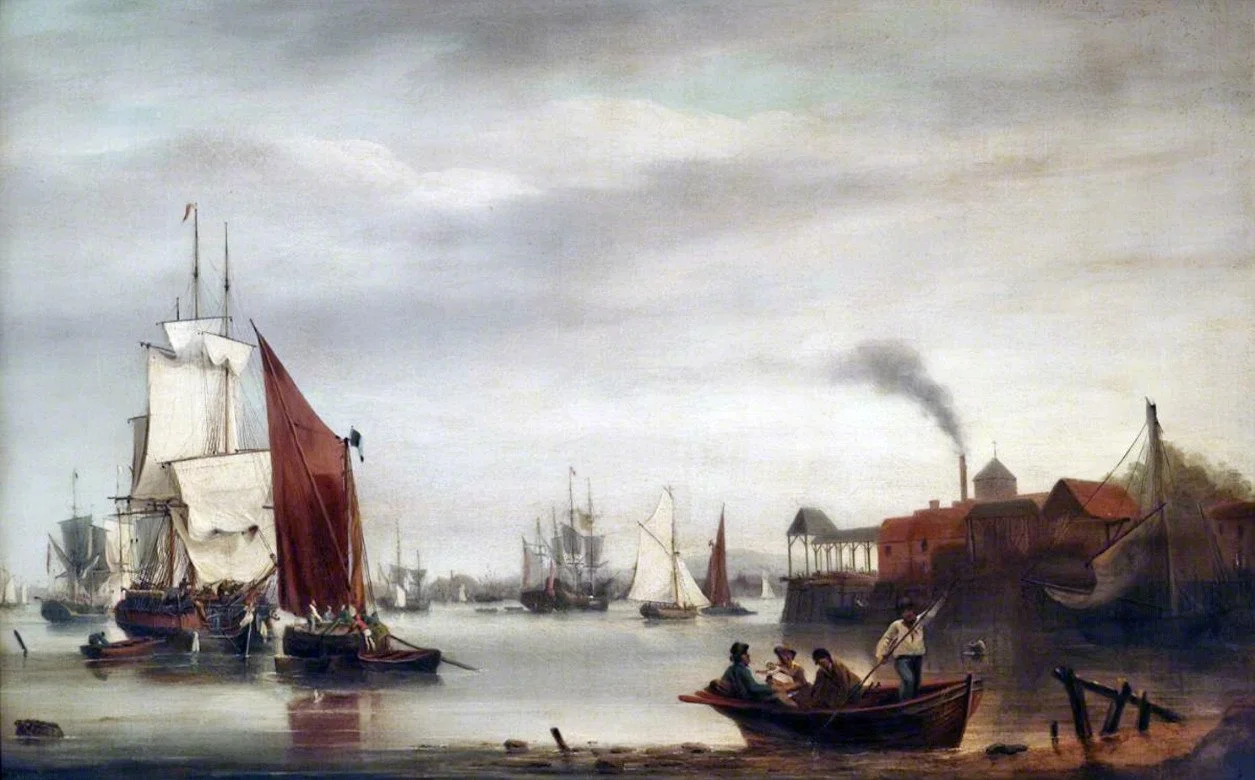
“Old Portsmouth Harbour" created by the British artist George Webster.
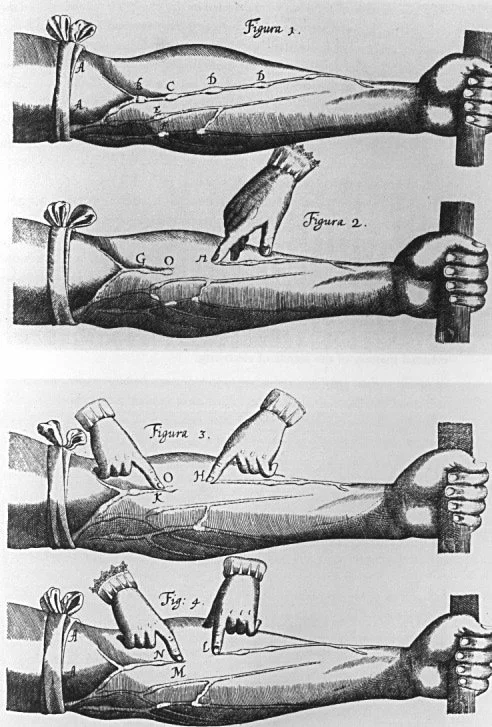
In 1628, William Harvey determined the true purpose and function of the heart, to circulate blood around the human body.
Nascent improvements in medical care also began with William Harvey’s discovery, in 1628, of the true purpose and function of the heart, to circulate blood around the human body. This marked the beginning of the end of the physician’s reliance on the hopelessly inaccurate theories of Greek physician Galen. It only took thirty years for Harvey’s ideas to become more widely accepted, breaking Galen’s 1,400-year stranglehold on medical advancement. The value of such new thinking was recognised by leading figures such as King James I. He supported Harvey’s research in the only way he knew how, inviting him to join his court as they hunted game, so that Harvey could dissect stricken animals immediately, in situ, and observe their blood flow.
In the early 17th century, growing access to printing technology dramatically expanded the output of presses from bibles, books and Shakespeare’s plays to mass-appeal news sheets. This had a major impact on communication and messaging during the Civil War, particularly as the number of people who could read had increased significantly, partly through the widespread adoption of the English language bible after the Protestant Reformation. Yet more inter-locking changes.
Not all were beneficial. For much of the first half of the 17th century, England enjoyed a prolonged period of peace while wars raged throughout Europe. These led to significant developments in the use of guns and explosives in battle. Sadly, when England returned to a war footing, it was for a civil conflict. Many Englishmen had served as mercenaries in the European campaigns and knew how essential these new weapons would be to military success.
The result was a proliferation of wounds and human hurt not experienced before on an English battlefield. Burns became ubiquitous, as were extensive fractures from cannon shot. Even the simple musket introduced a deadly new threat. Unlike the clean incision of a sword or pike, a musket ball carried a trail of garment fibres into the body as it broke through a soldier’s outer clothing and buried itself in its victim. Commonly, if the ball did not kill the man, the ensuing infection would. In this instance, medical science was trailing in the wake of the technology of warfare. It took another 200 years before Joseph Lister successfully combated infection. As ever, even when the growth of human knowledge was rapid, it was uneven.
Fascinating as all this might be, what value did it bring to my novels – the adventures of Thomas Tallant, ambitious young London spice merchant?
Well, it made me recast my thinking about the milieu of Tom’s world, before I had written a word. Beliefs firmly held for centuries were being challenged, in politics but also medicine and science. Society was slowly moving from a reliance on ancient or magical explanations to observed, empirical evidence.
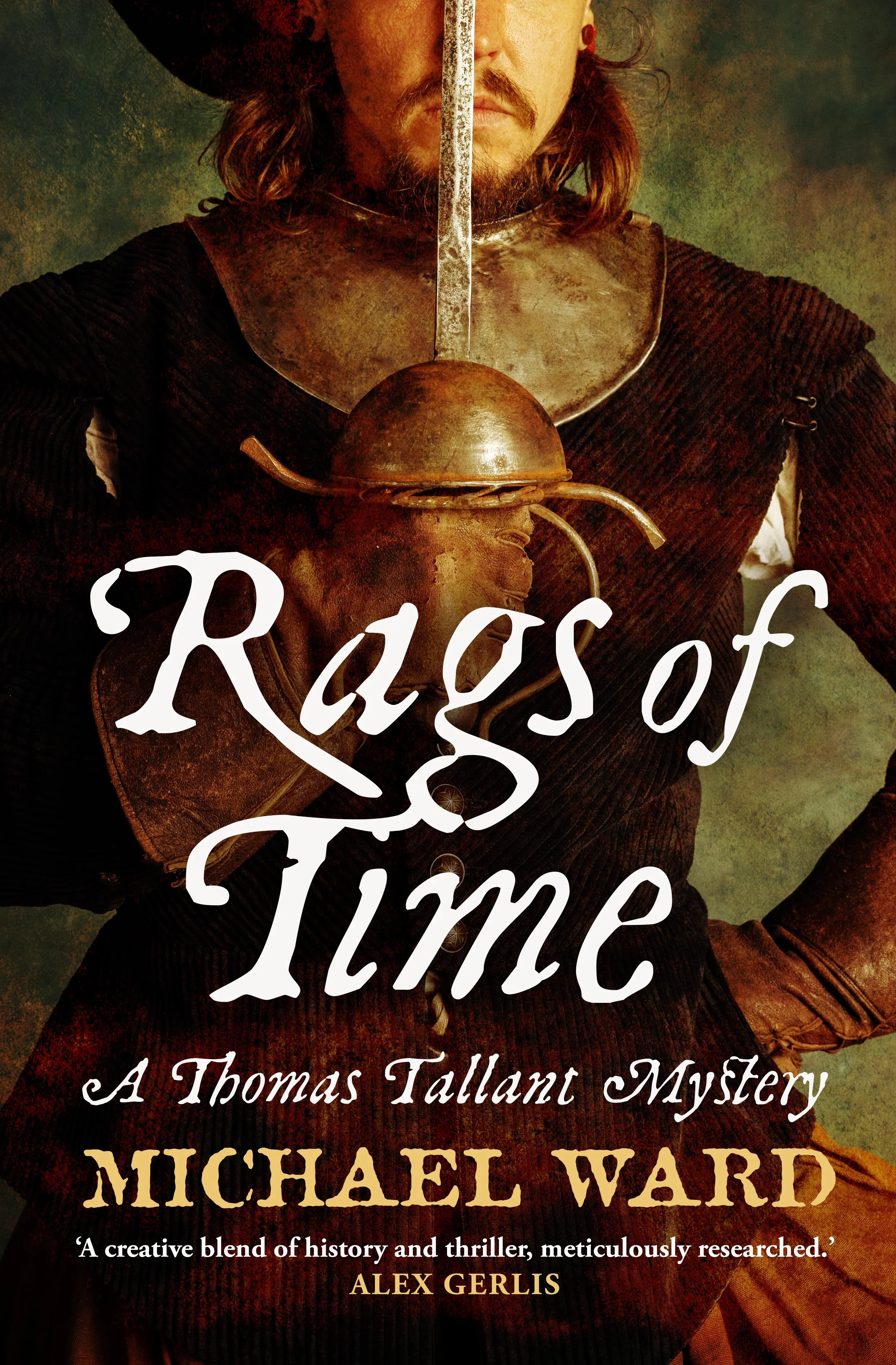
Was this new knowledge reaching the proverbial man and woman on a London street? Almost certainly not. But it was starting to change the world around them, and to ignore that would undermine my main intention. Because I, too, believe that storytelling is strengthened by historical integrity.
With each day, my study of Stuart history has brought new surprises and I’m sure will continue to do so. However, I doubt any will match a startling discovery I made one evening in my study, that made the hairs on the back of my neck stand up.
I was in the early stages of my first book and deciding on the nuts and bolts of my hero’s life – who were his family, where did they live and work, etc. I chose the name of Ralph for the father and decided, totally at random, on a particular dockside location for their London merchant business.
Many months later, I unearthed an online 17th century map of the city, the most detailed yet, with many more streets names than others I had seen. Scanning the screen, I came to the position I had chosen for my fictional merchant’s warehouse, only to discover that, almost 400 years earlier, someone had beaten me to it.
For there, in faded black and white, in the exact same location, was the unmistakable name ‘Ralph’s Quay’.

About the Author
Almost all of Michael Ward’s professional life has centred on writing. A former BBC journalist, he became a journalism teacher, and is still asked to run copywriting workshops to this day. After 25 years, he left university life behind to set up a content creation agency for business clients, but now devotes his energies to writing novels. So far, there are three Thomas Tallant Mysteries, with a fourth currently in research.
Alex Gerlis, best-selling author of historical espionage thrillers, describes Michael’s books as ‘meticulously researched, elegantly written’.