
The Cadet Nurse Corps: A Wartime Solution to a National Nursing Shortage
A Guest Blog Post by Marilee Aufdenkamp
When President Franklin D. Roosevelt signed the Nurse Training Act into law in June 1943, the country had already been at war for more than a year and a half, and the nursing shortage had reached a critical point. Hospitals were crowded, public health programs were expanding, and higher-paying wartime industry jobs were attracting young women who might otherwise have entered nursing. By the time the Corps was created, the nation faced an estimated seventeen thousand nursing vacancies. The federal government needed a solution that was fast, economical, and appealing to young women. Rather than return to the World War I approach of establishing federal nursing schools, the government chose a more efficient path: subsidize existing schools of nursing that met federal standards and were willing to reorganize their programs into a thirty-month structure. Nursing education had improved dramatically since the First World War, and the infrastructure was already in place. What the country lacked was a way to draw thousands of new students into the profession quickly enough to meet wartime needs. Administered by the U.S. Public Health Service’s Division of Nurse Education, the Cadet Nurse Corps became the federal government’s primary strategy for meeting that need.
One of the most compelling arguments for the Corps was that after nine months of training, it was believed that three student cadets could replace two graduate nurses, freeing the already-trained nurses for military duty. If the country could rapidly expand the number of student nurses, it could simultaneously staff civilian hospitals and release thousands of graduate nurses to serve overseas. The Corps was designed to make that possible.
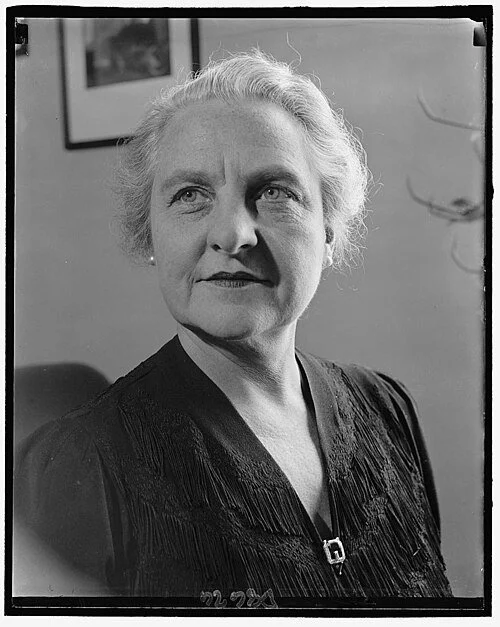
Ohio Congressional Representative Frances P. Bolton introduced the Nurse Training Act of 1943. Image courtesy of Wikimedia Commons - https://commons.wikimedia.org/wiki/File:Frances_P._Bolton_1940-3_seated.jpg
The Nurse Training Act, better known as the Bolton Act of 1943 (H.R. 2326), was introduced by Representative Frances Payne Bolton of Ohio, a longtime advocate for strengthening nursing education. The initial $65 million appropriation helped create what became the largest federally supported nursing education program in American history. One of its most impactful provisions, added in the Senate and strongly supported by First Lady Eleanor Roosevelt, was its nondiscrimination clause, which prohibited participating schools from excluding qualified applicants on the basis of race, color, or creed. Any school that wished to receive Cadet Nurse Corps funding had to comply. As a result, several previously segregated nursing schools admitted minority students for the first time, and nearly 3,000 African American, Japanese American, and Native American women entered the Corps.
The plan that emerged under the act was both practical and visionary. Schools that joined the program adapted their curricula, generally from a thirty-six-month to a thirty-month structure. This freed students for a final six-month period of full-time clinical service known as the senior cadetship. The federal government paid tuition, fees, room and board, textbooks, laundry, and uniforms. Cadets received monthly stipends—fifteen dollars during the pre-cadet period, twenty during the junior cadet period, and thirty during the senior cadetship (to be paid by the facility in which they were serving) if in a civilian facility; sixty if they served in a federal hospital. In return, students pledged to remain in essential nursing service, military or civilian, for the duration of the war. The pledge, however, was a gentleman’s agreement. The government’s contract was with the schools, not the students, and there were no penalties for those who left the program. Some cadets dropped out to marry; others left due to illness, homesickness, or academic difficulty. Even so, the program succeeded on a scale few anticipated.
The level of participation was enormous. Of the 1,312 nursing schools in the United States that met federal standards, 1,125 joined the program. Between 1943 and 1945, 179,294 students enrolled, representing eighty-three percent of all students admitted to participating schools during that period. Nearly seventy percent completed their training. At the height of the war, student nurses were providing eighty percent of the country’s nursing care in more than a thousand civilian hospitals. The Corps became the backbone of wartime nursing, filling gaps left by graduate nurses who entered military service and sustaining civilian hospitals that were strained by many factors, including an increased demand for civilian medical care as the nation recovered from the Depression, the expansion of Social Security, the trend away from home births, and the loss of nurses to jobs created by new public health programs.
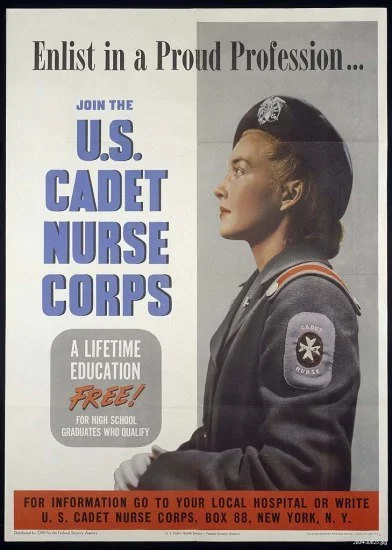
Recruitment posters such as these attracted young women to the Cadet Nurse Corps
To support recruitment, the federal government invested heavily in how the Corps presented itself to prospective students, and the uniform became a central part of that effort. Those directing the campaign knew that enticing young women to enter nursing depended on more than funding alone; their efforts had to appeal directly to the young women they hoped to attract. One of the most successful strategies was the creation of a distinctive Cadet Nurse Corps uniform. The outdoor uniforms were created by top fashion designers and chosen in a competition at the Waldorf-Astoria in New York City, a glamorous setting that signaled the government’s intention to make nursing look modern and desirable. Each cadet received a summer and winter suit, a winter coat, raincoat, blouse, beret, handbag, and sleeve insignias portraying the Maltese cross, the emblem of the U.S. Public Health Service. The summer uniform was made of gray-and-white striped cotton and worn with a gray felt hat with a red band. The winter uniform was a lined gray wool-flannel suit with silver buttons and a scarlet oval bearing a silver Maltese cross. The beret featured the staff of Aesculapius, the winged staff of Mercury, and a fouled anchor. The cost of the winter suit—jacket and skirt together—was $16.04. The J.C. Penney Company handled the mail-order contract, ensuring that uniforms could be distributed nationwide.
The uniform included several symbolic elements. Gray represented mercy, serenity, and understanding; scarlet symbolized strength, courage, and inspiration; the fouled anchor was a symbol long associated with wounded sailors; and the eight points of the Maltese cross represented the eight beatitudes. Cadets received a booklet titled “Figuratively Speaking,” which instructed them on posture, grooming, and how to wear the uniform properly and with pride. Wearing the outdoor uniform was optional, but when worn, it carried social advantages. Cadets traveling by train were allowed to board early alongside servicemen. The uniform even inspired a cosmetic tie-in: a lipstick and rouge set in a shade called Rocket Red, packaged in a gray case decorated with a Maltese cross.
The federal government spent nearly thirteen million dollars on recruiting, an extraordinary sum for a nursing program. Marketing materials included pamphlets and posters created by well-known commercial artists, including Jon Whitcomb, whose glamorous illustrations helped define the public image of the Cadet Nurse Corps. Cadets appeared in newsreels, movie trailers, and in photographs with Washington insiders. They smiled from the covers of Collier’s, Harper’s Bazaar, and The Ladies’ Home Journal. Hollywood joined in with Reward Unlimited, a short film starring Dorothy McGuire as a heroic cadet nurse. Radio spots aired on more than three hundred programs, including the memorable line, “Do You Want to Be a Girl with a Future?”
The campaign worked. The federal government had established a goal of recruiting 65,000 new students in the first year—twice the number of new nursing students admitted annually before the war—and participating schools were asked to double their enrollments. The goal was exceeded by five hundred twenty-one, and by the end of that year, eighty-five percent of all students in participating schools were Cadet Nurses.
Training followed a structured progression: the pre-cadet period occurred during the first nine months, the junior cadet period during the next fifteen to twenty-one months, and the senior cadetship during the final six months of full-time clinical service. Senior cadets served in Army hospitals, Navy hospitals, Veterans Administration hospitals, Indian Service hospitals, Public Health Service hospitals, and civilian hospitals across the country. Those serving in Army facilities held officer privileges, with access to officers’ clubs and recreational facilities. After graduation, cadets who entered the Army Nurse Corps did so as second lieutenants. The senior cadetship was often the most formative part of a cadet’s training, offering independence, responsibility, and exposure to the full range of wartime medical care.
As a cost containment measure, students who enrolled after June 30, 1945, did not receive the full outdoor uniform; instead, they were issued a single washable sleeve patch and one lapel insignia to wear on their indoor uniforms. Following the surrender of Japan in August 1945, the final date for new student admission was set for October 5, 1945. At that moment, 116,498 students were still in training, and another 3,000 were admitted for the fall and final term. Even though the war ended on September 2, 1945, students from the final enrollment period were permitted to complete their training. The program remained operational until 1948 and encompassed three enrollment periods—1943, 1944, and 1945. During that time, 179,294 student nurses enrolled, and 124,065 graduated from participating schools.
By the time the program concluded in 1948, the federal government had spent more than $160 million on tuition, stipends, uniforms, recruiting, and administration. The Cadet Nurse Corps expanded the nursing workforce during a period of national need and opened the profession to thousands of young women who might not otherwise have afforded training.


About the Author
Marilee Aufdenkamp is a retired nurse turned historical fiction writer. Her debut novel, Sparrow’s Song, forthcoming from Old Fort Press in September 2026, follows a young woman from the community of Germans from Russia who immigrated to Nebraska as a child early in the twentieth century. The novel traces the protagonist’s years as a student in the Army School of Nursing during World War I through her years as an instructor in a Cadet Nurse Corps participating school during World War II. Marilee shares weekly historical features connected to her research on Instagram @marileeaufdenkampwriting, or learn more at www.marileeaufdenkamp.com.