
Singing for Glory: Music in Late Victorian England
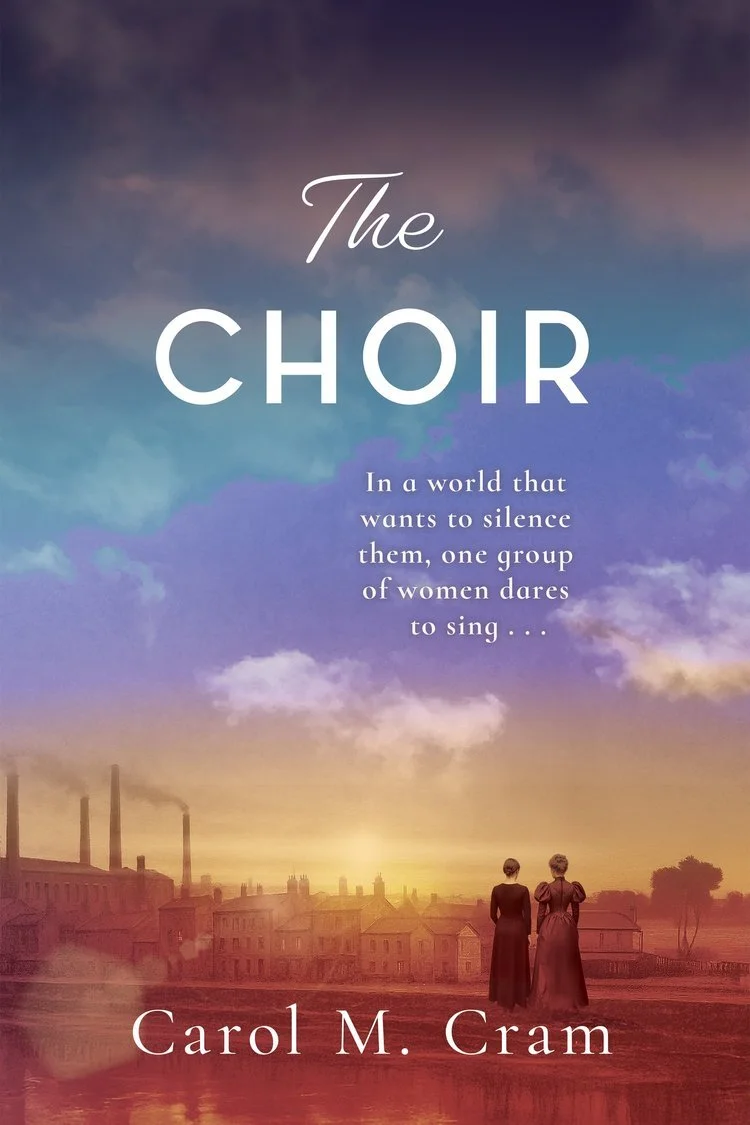
Music is at the heart of The Choir. Through music, both main characters and many of the supporting characters find fulfillment and self-actualization.
I have played music for almost my entire life. When I was five, my parents bought a piano and signed me up for lessons. Later, in elementary school in Vancouver, Canada, I was fortunate to have a music teacher who regularly entered her students in choir competitions. To this day, I still sit down at the piano to play a few Bach Inventions before beginning a writing session.
While writing The Choir, I took singing lessons so I could experience what singing feels like, even if the sounds emerging from my mouth were not always the most tuneful. I also sat in on choir rehearsals to observe how an experienced conductor shapes a group of individual voices into a unified whole.
My lifelong fondness for choral music is one of the reasons I set The Choir in 1890s Yorkshire. During this period, music, and particularly music competitions, played a significant role in many people’s lives.
Thousands of working people joined choirs, formed brass bands, and traveled by rail to compete for prizes, prestige, and pride. For many, music was far more than entertainment. It was aspiration, identity, and occasionally escape.
A Choral Explosion
Choral singing had long been associated with church life, but in the second half of the nineteenth century it expanded into the secular sphere. Industrial prosperity, railway expansion, and rising literacy rates all contributed to the rapid growth of organized musical culture.
By the late Victorian period, large-scale choral festivals were drawing thousands of participants and audience members. Events at London’s Crystal Palace showcased enormous choirs performing Handel, Mendelssohn, and newly commissioned works.
Thanks in part to the tireless efforts of Mary Wakefield, who makes a cameo appearance in The Choir, the music competition movement grew and flourished. Across Yorkshire, Lancashire, and the Midlands, small towns established their own choral societies and competitive festivals. These competitions, often held in town halls or public assembly rooms, attracted all levels of society. Mill workers, shop assistants, clerks, and domestic servants rehearsed in the evenings after long shifts.
Music was no longer confined to drawing rooms or cathedrals. It belonged to the community.
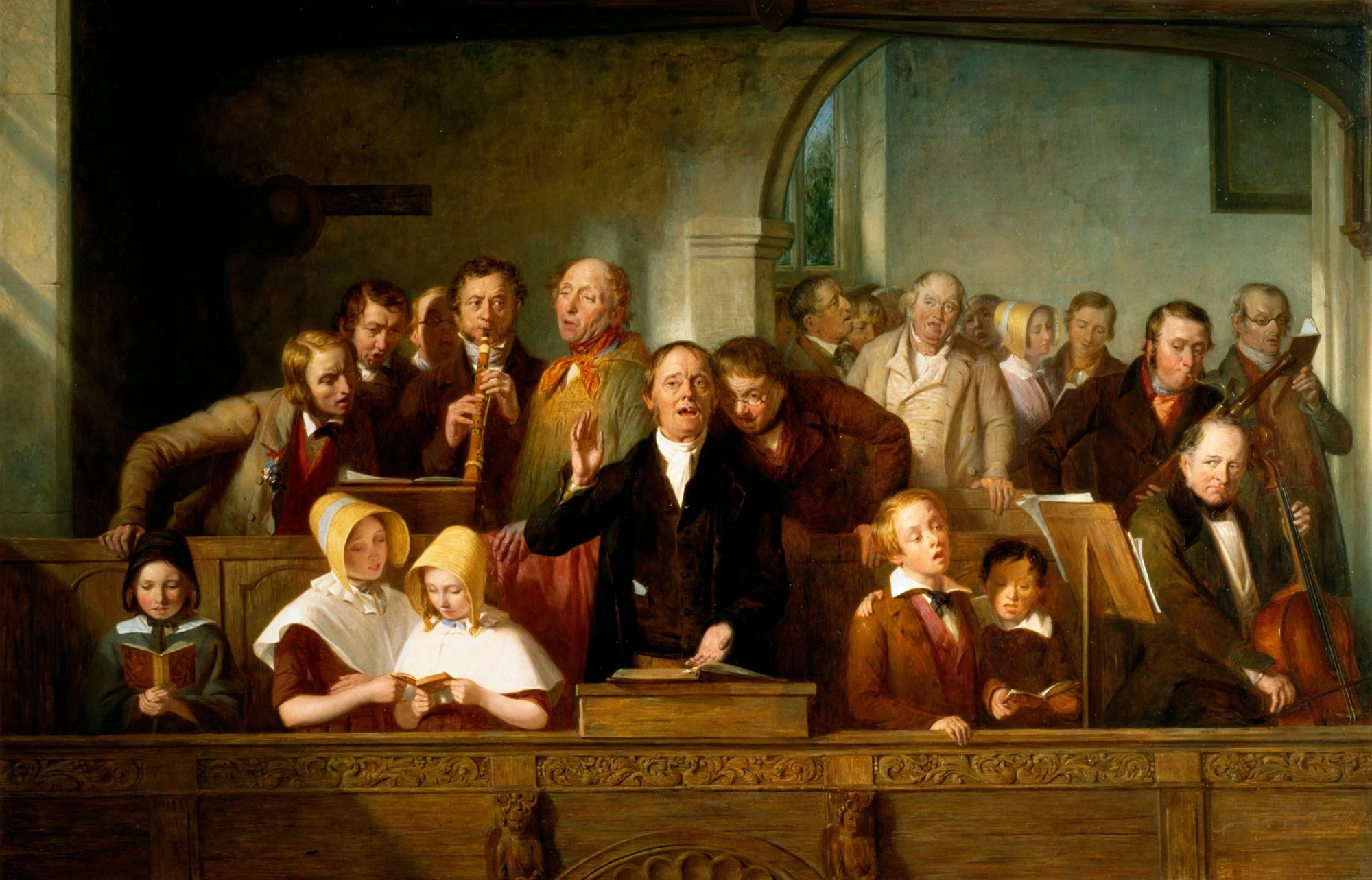
“A Village Choir” by Thomas Webster (1800-1886) - https://en.wikipedia.org/wiki/A_Village_Choir#/media/File:Thomas_Webster_-_A_Village_Choir.jpg
Competition as Community
Music competitions were structured and disciplined events. Choirs prepared prescribed test pieces, often sacred anthems or excerpts from larger choral works. Adjudicators, frequently respected conductors or composers, offered detailed critiques. Trophies, certificates, and sometimes cash prizes were awarded.
Rehearsals demanded discipline, listening skills, and cooperation. Sopranos had to trust altos. Tenors had to hold their line against the basses. Each voice mattered, but only within the collective.
While researching the novel, I was struck by how frequently local newspapers reported on choral contests. Columns that might otherwise have chronicled accidents or municipal debates devoted generous space to musical triumphs. Winning a competition brought honor not only to the choir but to the town itself.
Industrial communities competed musically just as fiercely as they did commercially.
For working-class women in particular, choir membership could be transformative. Respectable public singing was socially acceptable in a way that other forms of visibility were not. A married woman might have limited authority in her own home and no political voice in the nation, yet in a choir she contributed to something larger than herself.
Her voice was heard.
Musical Life in London
London in the 1890s pulsed with theatrical and musical life. Comic opera, light opera, and operetta flourished, especially the works of W. S. Gilbert and Arthur Sullivan.
In The Choir, Ruth Henton stars as Yum-Yum in The Mikado and is courted by the Prince of Wales, while her childhood friend Eliza Kingwell sings in northern competitions. Though their stages differ dramatically in scale, both women are shaped by the same cultural phenomenon, a Britain intoxicated by organized music.
Audiences for these performances crossed class boundaries. Shop assistants crowded into the gallery. Clerks and tradesmen filled the stalls. Aristocrats occupied the boxes. Music, whether competitive or theatrical, created rare spaces in which multiple layers of society shared the same emotional experience.
More Than Prizes
When we look back at Victorian industrial towns, we often see statistics such as production figures, export totals, and mortality rates. Those numbers matter.
But they do not capture the soundscape.
Imagine a mill worker finishing a twelve-hour shift amid the clatter of looms, then hurrying home to wash, eat, and attend rehearsal. Imagine the shift from mechanical noise to human harmony, from isolated labor to collective breath.
Singing in a choir or playing an instrument in a company band did not erase hardship. These activities existed alongside poverty, overcrowding, and exhausting work. Yet they remind us that working-class culture was not culturally barren. It was vibrant, ambitious, and self-improving.
The industrial North did not merely manufacture textiles and machinery.
In church halls and town auditoriums across England, ordinary men and women discovered that their voices, joined together, could fill a room and sometimes change a life.


About the Author
Carol M. Cram is the award-winning author of the Women in the Arts Trilogy (The Towers of Tuscany, A Woman of Note, and The Muse of Fire), the contemporary novel Love Among the Recipes (which received a Publishers Weekly Starred Review), and her forthcoming historical novel The Choir. She also hosts the Art In Fiction Podcast, where she interviews authors who write novels inspired by the arts, and writes a travel blog called The Artsy Traveler.
Before becoming a full-time novelist, podcaster, and blogger, Carol authored over sixty bestselling textbooks in computer applications and business communications for Cengage Learning and Houghton Mifflin. She holds an MA in Drama and an MBA, and taught for many years on the faculty at Capilano University. She lives on Bowen Island near Vancouver, Canada with her husband, visual artist Gregg Simpson.