
Seeing the Elephant: The American Dream of the Extraordinary
A Blog Post by Jane D. Cairns
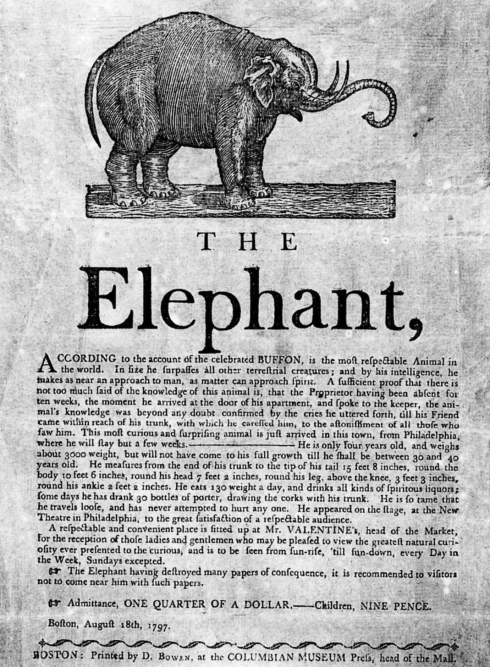
Illustrated broadside advertising Crowninshield’s Elephant
During the Civil War, the Andover (Massachusetts) Advertiser newspaper printed regular letters from correspondent Stephen Burris, a local printer who had enlisted as a private. Burris was a skillful writer, detailing the activities and movements of the Massachusetts 14th Regiment's Company H, made up of men from the town, as well as vivid details of their everyday lives in the camps. The company was trained as Heavy Artillery and spent the first years of the war manning the hill-mounted guns ringing Washington, D.C. The men were often bored and frustrated, Burris wrote, and longing for action. In August 1862, however, the regiment received the news it had been waiting for. They had been reclassified, a visiting colonel informed them, into light infantry, and would very soon "see the elephant." (1)
In December 1848, Dedham, Massachusetts, native George Holbrook Baker was working as an artist in New York City when news of the California gold discovery caught his attention. He went home to Boston, where he joined eleven other "respectable young gentlemen" in forming a mining company called the New England Pioneers. The group left for California in January 1849, traveling via New Orleans, the Gulf of Mexico, Mexico, and eventually San Francisco. Baker reached the California goldfields that June, but after trying his luck mining on the North Fork of the American River, he gave up in less than two weeks. On July 4, 1849, he went back toward Sacramento, writing that he was "satisfied with having seen the elephant." (2)
And in 1857, the New York Clipper, a newspaper devoted heavily to theatrical and circus news, published a notice about the famous elephant Hannibal, described as a "monster of mammoth proportions."
"All those who have heretofore been disappointed in seeing the elephant, can now have an opportunity of examining him at the menagerie of Van Amburg & Co., now on show at Palace Gardens." (3)
What do these stories have in common? All three are examples of the common nineteenth-century idiom "to see the elephant," used as an expression for any kind of adventure or exciting experience. The first two demonstrate the expression's underlying bittersweet sense of discovering the true nature of an experience and paying its price. The third is less metaphorical, taking for granted that its readers knew the idiom. The Clipper's writer exploits the fact, for witty effect, that Hannibal was physically available to be seen.
The idiom appears to have an older linguistic ancestry, (4) but by the nineteenth century "seeing the elephant" had become distinctly American in both its popularity and its associations.
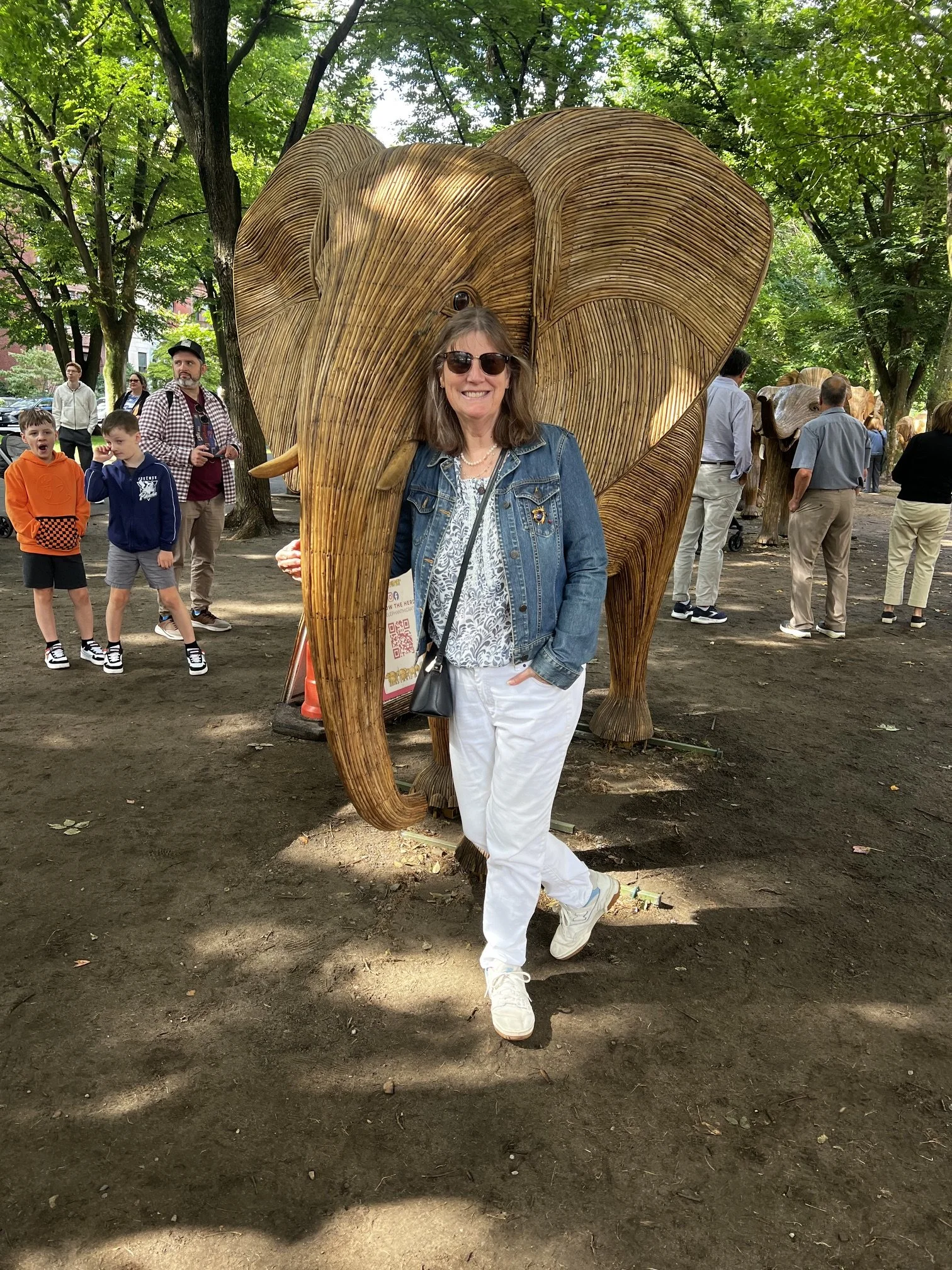
Jane D. Cairns visiting the global public art exhibition, The Great Elephant Migration, which draws hundreds of thousands of visitors each year in cities around the world.
Why an elephant? They are, of course, not merely the object behind the idiom but have deep cultural and spiritual significance for many societies around the world. Conservationists recognize them as a keystone species, crucial to maintaining the structure and health of their native ecosystems. But long before most Americans had any possibility of understanding their ecological significance, much less encountering one in the wild, the elephant had become a familiar figure in American popular culture: enormous, exotic, intelligent, and almost impossibly strange.
Elephants arrived in America as spectacles. They appeared in menageries, circuses, museums, advertisements, political cartoons, children's books, and popular prints, and yet their very existence seemed improbable. To see an elephant in the flesh was to encounter something that seemed to have wandered in from another world. The phrase also contained a built-in tension between anticipation and experience. Once you had seen the elephant, the mystery was gone. The creature that had seemed almost mythical turned out to be only a physical animal, magnificent but also cumbersome, hungry, temperamental. The soldier who finally saw the elephant discovered that battle was not necessarily the glorious adventure he had imagined. The gold seeker discovered that California's riches required backbreaking labor and offered no guarantee of success. To "see the elephant," in other words, was to discover what happens when a dream collides with reality.
That same tension between aspiration and experience runs through my novel Exalted Objects and Tim Schooley's Circus of the Vanishing Elephant, both released in September 2026 by HTF Publishing. Characters in the two stories pursue an elephant precisely because it seems too large, too fantastical, or too improbable to possess. They must work to discover whether the extraordinary thing they have pursued can live up to the extraordinary place it has occupied in their minds. The elephant in these stories is therefore both real and an illusion. It is an animal, a spectacle, a dream, and a metaphor for the tantalizing possibility that somewhere beyond the familiar is something enormous waiting to be seen.
In that sense, the nineteenth-century expression still feels surprisingly contemporary. We continue to pursue our own elephants: extraordinary objects, improbable adventures, distant places, impossible ambitions, and experiences we imagine will somehow change us. Sometimes they do. Sometimes they disappoint us. And sometimes the pursuit itself is the real adventure.
Footnotes:
Andover Advertiser, September 7, 1862
Anecdote cited in Anthony Kirk, “Seeing the Elephant,” in A Golden State: Mining and Economic Development in Gold Rush California, University of California Press, 1999, pp. 174–75.
“New York City,” New York Clipper, December 26, 1857, pp. 286–287. A transcription is available on the Circus Historical Society's website New York Clipper Excerpts 1850s
For more fascinating detail, see Charles Clay Doyle, "‘To See the Elephant': Meanings of the Proverbial Phrase, and Its Age," Proverbium 39, no. 1 (2022): 58–85, DOI 10.29162/pv.39.1.59.

About the Author
Jane D. Cairns is a Massachusetts-based writer and grassroots local historian. She is an active member of GrubStreet in Boston and a graduate of its highly selective Novel Incubator program. An alumna of Smith College, she has worked as a columnist and researcher for numerous trade magazines, including Publishers Weekly and Library Journal. Currently, she serves as a board member of the Andover (Mass.) Center for History and Culture, where she speaks and writes on popular topics in social and economic history. When she isn’t reading or writing, you can likely find her hiking with her husband on regional trail systems, riding her class-1 e-bike, or chasing critters out of her organic vegetable garden. Exalted Objects is her debut novel.

A railroad tycoon must choose between his brother’s freedom and his own ambition—before one wild act shatters both their lives.
“Jane D. Cairns’s tale of two very different brothers is an astonishing feat of the imagination, pitching order against poetry, wealth against refuge, power against family—testing the reader’s sympathies in a wholehearted exploration of two visions of what America, in her golden adolescence, might have become.”
— Michelle Hoover, author of The Quickening and Bottomland and host of The 7am Novelist Podcast