
Depot Dining in the Era of Steam Engines: Fred Harvey and the Harvey House Model
A Guest Blog Post by Marilee Aufdenkamp
Fred Harvey was an English immigrant who liked to tell friends he came to the United States in 1850 at age fifteen, though he actually arrived in 1853 at age seventeen. He later told a colleague that he left to avoid the draft because Great Britain was about to join the Crimean War. He entered an American restaurant world still in its infancy. Delmonico’s in New York City had become the first full‑service restaurant in the United States just over twenty years earlier. At Smith & McNell’s, a standout in the New York restaurant scene, he worked his way up over eighteen months from dishwasher and pot scrubber, or pot walloper, to line cook, soaking up everything he could about the developing industry.
Harvey and a partner later ran a successful restaurant in St. Louis, but the Civil War and talk of Missouri seceding from the Union ended the venture. Harvey was antislavery; his partner was a Confederate sympathizer who fled to join the secessionist army and took all their savings with him. After the loss, Harvey worked for a friend in the steamboat trade on packet boats before taking a job as a government postal clerk. He soon moved into the new practice of sorting mail on moving trains, the precursor to the national Railway Mail Service.
A natural businessman with a talent for making connections, Harvey caught the attention of railroad officials. He became a ticket agent for the Hannibal & St. Joseph Railroad and was relocated to Leavenworth, Kansas, where he opened a ticket booth in the lobby of the fashionable Planter’s House hotel and restaurant. The bombastic mayor Daniel Read Anthony, Susan B. Anthony’s brother, frequently held court there, and Harvey made the most of the setting. He also took a second job selling ads and subscriptions for the Leavenworth Conservative as the paper’s general business agent. The Harveys loved Leavenworth, but they moved on when it became clear the town would not become a major railroad hub.
Though railroad expansion slowed in the early 1870s amid the Credit Mobilier scandal and the broader financial instability that led to the Panic of 1873, rail travel in the American West still grew rapidly in the late nineteenth century. During this period, Harvey was made a General Western Agent west of the Mississippi for freight for the Chicago, Burlington & Quincy Railroad. His work sent him crisscrossing the West by train, giving him firsthand experience with the dismal state of rail-side dining.
Passenger trains had no kitchen facilities, and the depot cafes available along the way were known for rushed meals, poor sanitation, and inconsistent service. Travelers had only a short time to eat whatever was available before the train moved on, and the quality varied wildly. Many depots reflected the roughness of frontier towns, where cleanliness and order were not guaranteed. Harvey saw the disorder of depot dining as an opportunity and had a clear idea of how to fix what wasn’t working.
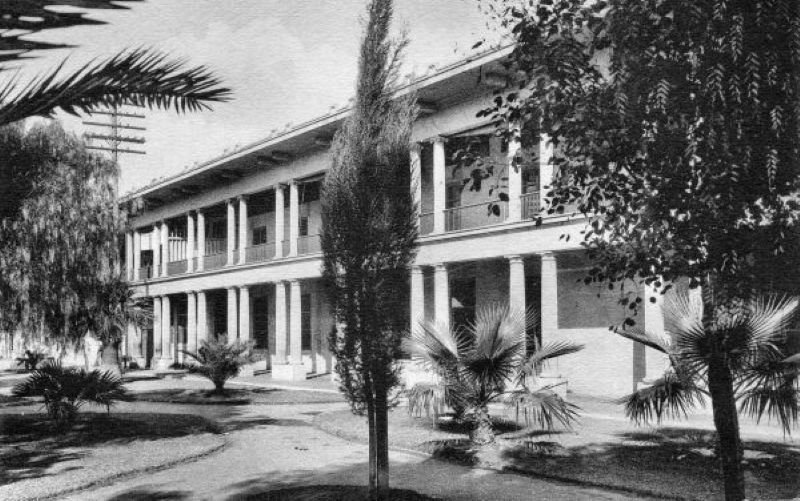
Harvey House Depot
In 1876, Harvey first pitched his idea for a network of high‑quality depot restaurants to the Chicago, Burlington & Quincy Railroad, but they declined. He then approached the Atchison, Topeka & Santa Fe Railway, which was expanding westward and saw promise in his proposal. That same year, the first Harvey House—dining only—opened in Topeka. Two years later, the first full‑scale Harvey House—dining plus lodging—opened in Florence, Kansas, in the former Clifton Hotel just south of the tracks and southeast of the depot. The building now operates as a museum. It was an immediate success, and the Santa Fe Railway soon partnered with Harvey to build more. Over time, the Harvey system grew into a chain stretching from Kansas to California, offering dependable meals and lodging in towns that had grown rapidly around the railroad.
The spacing of Harvey Houses, roughly one hundred miles apart, was not arbitrary. Steam engines consumed enormous quantities of water, and they needed to refill frequently. A reliable water stop every hundred miles was essential, and Harvey Houses were built at or near these stops to serve passengers during the locomotive’s servicing window. Most were integrated into depot complexes, either inside the station itself or as an attached wing, so passengers could step off the train, walk a short distance into the dining room, eat a full meal, pay, and reboard within the thirty‑minute servicing window.
This proximity allowed Harvey Houses to operate with remarkable precision. Conductors took dining orders onboard and telegraphed them ahead to the kitchen. A train spotter down the track notified staff of the train’s approach. When the locomotive blew its whistle one mile from the depot, the dining room prepared for service. By the time passengers stepped inside, their meals were ready. This streamlined system allowed travelers to eat efficiently and reboard on time. It became a model for modern hospitality long before chain restaurants or standardized lodging were common.
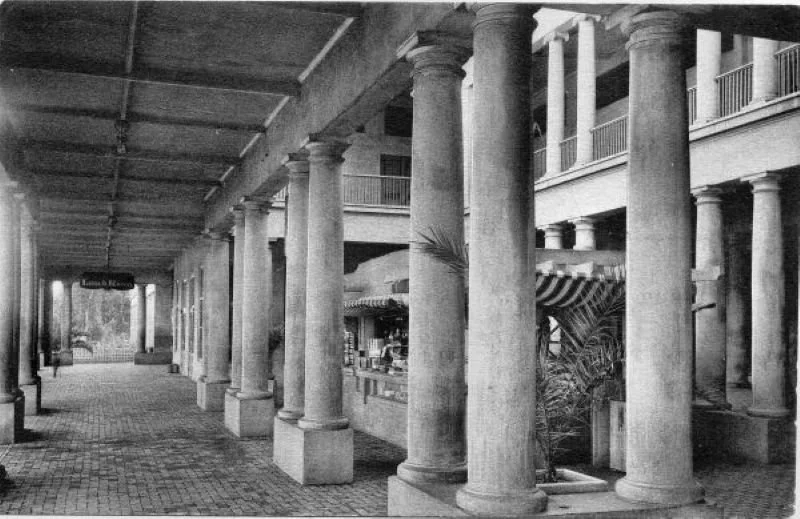
Under the porch of a Harvey House
Harvey Houses were known for their elegance and consistency. Dining rooms featured white linen tablecloths, fine china, silver service, and menus that included steaks, fresh trout, soups, and homemade pies. Men were required to wear jackets, and a supply was kept on hand for those who arrived without one. Many Harvey Houses offered both a casual lunchroom and a formal dining room, and some included bakeries, gift shops, or full hotels. The surroundings were intentionally refined. Culture and elegance were hallmarks of Harvey’s hospitality empire, and he believed travelers should experience dignity and comfort even in remote towns.
To staff his dining rooms, Harvey hired young women, usually between eighteen and thirty, who signed six‑month contracts and lived in supervised dormitories. They were expected to be intelligent, well‑mannered, and of good moral character. Appearance and conduct were closely monitored by a house mother, sometimes the senior Harvey Girl, who enforced curfews and behavioral standards. Early uniforms consisted of black dresses, crisp white aprons, polished black shoes, black stockings, and white ribbons. Harvey Girls received six weeks of training and were often placed at smaller Harvey Houses before working their way to larger, more prestigious locations. Their professionalism helped stabilize frontier towns, and many stayed to build lives in the communities they served.
Sometime in the 1880s, once the Harvey House model had proven itself and the existing houses were netting the modern equivalent of more than $1.1 million annually, Harvey moved his family back to Leavenworth and purchased a twelve‑room mansion with seven fireplaces at Seventh and Olive Streets. The home, now the National Fred Harvey Museum, is currently under restoration, with tours available by special arrangement.
Prior to 1887, Harvey Houses had only been located as far west as Albuquerque. When the Atchison, Topeka & Santa Fe announced it was going to extend its line all the way to California, Harvey made plans to open eight new Harvey Houses along the desert corridor through Arizona and into California, where the line’s westernmost stops lay in the Mojave Desert. These houses offered reliable food and lodging in places where travelers had previously faced long, dry stretches with few services.
The push west demanded a steady hand, and Harvey approached it with the same exacting standards that defined his entire enterprise. His fastidious, disciplined manner—shaped by a refined English gentleman’s persona—guided every decision. He believed in offering the finer things, paid close attention to service, and understood how to turn relationships into opportunity.
The Harvey Girls, already central to the system, felt these standards most directly. To them, he could be a tyrant, berating servers over even a single smudge. He insisted on “the Fred Harvey Way” and made surprise inspections. Only orange juice squeezed after it was ordered could be served; anything prepared ahead was thrown out. Coffee in the gleaming urns was emptied every two hours—unheard of in restaurant practice at the time—and replaced with freshly ground beans from Boston.
To improve efficiency, Harvey developed a cup‑placement system so drink girls could read orders instantly. While the girls followed strict codes of conduct, managers and chefs—many trained in the East—were encouraged to be entrepreneurial, sourcing the freshest ingredients and using them creatively in the name of quality.
The idea that led to the Harvey Girls did not come directly from Harvey himself but from employee Tom Gable, the son of a family friend Harvey had known since the young man’s childhood. Harvey was having problems with rough and rowdy gunslinger types who were showing up at the Raton, New Mexico establishment, a common issue at train depots in that era but particularly troublesome there. At Gable’s suggestion, Harvey replaced the Black male waiters with young female servers recruited from Kansas and the eastern United States, believing they would provide a calming effect and influence the men to practice improved behavior. Women were scarce in the West at that time, and many Harvey Girls ended up marrying locally and becoming civically and socially active in their communities. Harvey Girls were required to sign a contract agreeing to remain single and stay on the job for six months. If they fulfilled that obligation, they were rewarded with a vacation that included a free ticket for train travel anywhere along the Santa Fe line.
The Harvey network eventually included dozens of restaurants, lunchrooms, and hotels along the Santa Fe line. While many buildings were demolished after the decline of passenger rail, several remain standing today, each with a different role in its community. The former Harvey House in Dodge City, Kansas, now serves as a community theater. La Posada in Winslow, Arizona, designed by architect Mary Colter, has been restored and continues to operate as an elegant hotel and restaurant, though no longer a Harvey House. Casa del Desierto in Barstow, California, now houses museums and city offices. El Garces in Needles, California, once considered a crown jewel of the Harvey system, now serves as office space. These surviving buildings represent only a small portion of the original network, but they illustrate the reach and influence of the Harvey House system.
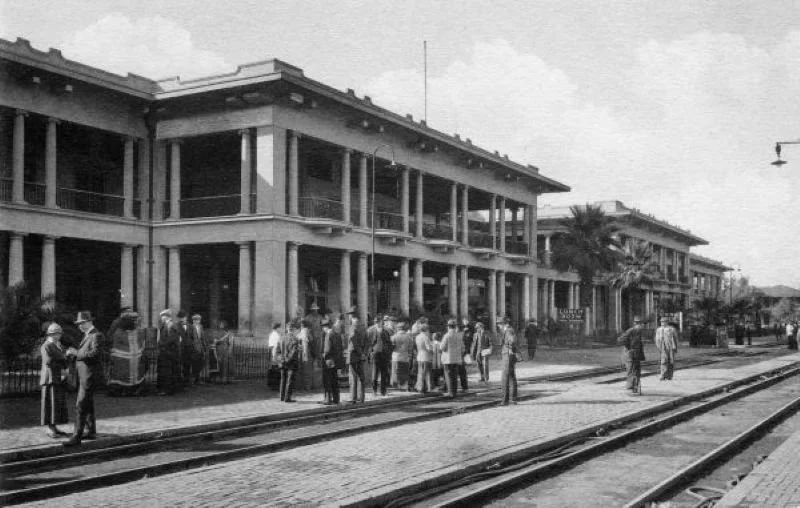
Harvey House Track Side
When Route 66 was established in 1926, it often followed the Santa Fe Railway’s path. That meant many Harvey Houses, already serving rail passengers, became natural stopping points for early motorists. Travelers driving the National Old Trails Road and later Route 66 encountered Harvey Houses in towns like Winslow, Barstow, and Needles. Some Harvey Houses adapted to serve both rail passengers and motorists. Others struggled as passenger rail declined. The rise of diesel locomotives, which required fewer stops, reduced the need for depot restaurants. Onboard dining cars also improved significantly, offering meals that rivaled high‑end restaurants. By the late 1940s, many Harvey Houses closed their dining rooms or hotels, marking the end of an era.
The decline of Harvey Houses reflected broader changes in American travel. Railroads no longer dominated long‑distance transportation. Automobiles and highways reshaped the landscape, and later, commercial air travel transformed it again. The Harvey system, built for the steam era, could not fully adapt to these shifts. Yet the influence of Harvey Houses endured. They set standards for cleanliness, efficiency, and professionalism that shaped the hospitality industry for decades.
Harvey Houses brought structure and reliability to places that had grown quickly around the railroad. The Harvey Girls helped stabilize communities, set expectations for service, and offered young women opportunities for independence at a time when those options were limited. Today, the remaining Harvey Houses stand as reminders of a hospitality network that transformed Western travel. Their legacy endures along the old Santa Fe line and the corridor later followed by Route 66, which is celebrating its centennial this year. The story of the Harvey system is a story of innovation, discipline, and the women whose work helped shape the American West.

About the Author
Marilee Aufdenkamp is a historical fiction writer with a special interest in Harvey House culture and the women who shaped life along the Santa Fe line. Readers can visit her website for more on Harvey Houses, including a free short story set at the El Garces Harvey House in Needles, California, and photos from her family’s Mansker archives. She also recommends Stephen Fried’s Appetite for America for the definitive history of Fred Harvey.